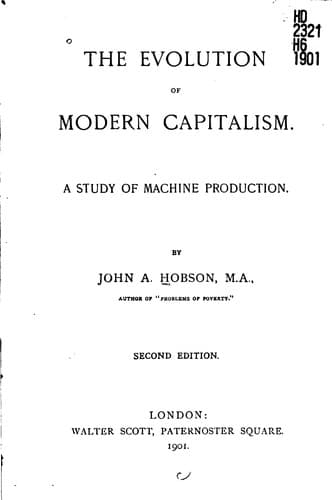
The Evolution of Modern Capitalism: A Study of Machine ProductionHobson, J. A. (John Atkinson)
History
The Evolution of Modern Capitalism: A Study of Machine Production
Hobson, J. A. (John Atkinson)
Capitalism; Industries -- History; Machinery in the workplace
The condition of the cotton-trade in Lancashire about 1750
illustrates most clearly the transition from the independent weaver to
the dependent weaver. So far as the linen warp of his fabric was
concerned he had long been in the habit of receiving it from the
larger "manufacturer" in Bolton or in Manchester, but the cotton yarn
he had hitherto supplied himself, using the yarn spun by his own
family or purchased by himself in the neighbourhood. The difficulty of
obtaining a steady, adequate supply, and the waste of time involved in
trudging about in search of this necessary material, operated more
strongly as the market for cotton goods expanded and the pressure of
work made itself felt.[45] It was this pressure which we shall see
acting as chief stimulus to the application of new inventions in the
spinning[46] trade. In the interim, however, the habit grew of
receiving not only linen warp but cotton weft from the merchant or
middleman. Thus the ownership of the raw material entirely passed out
of the weaver's hands, though he continued to ply his domestic craft
as formerly.[47] This had grown into the normal condition of the trade
by 1750. The stocking-trade illustrates one further encroachment of
the capitalist system upon domestic industry. In this trade not only
was the material given out by merchants, but the "frames" used for
weaving were likewise owned by them, and were rented out to the
workers, who continued, however, to work in their own homes.[48]
§ 12. Two further steps remained to be taken in the transition from
the "domestic" to the "factory" system, the one relating to the
ownership of "power," the other to the work-place, (_a_) The
substitution of extra-human power owned by the employer for the
physical power of the worker; (_b_) the withdrawal of the workers from
their homes, and the concentration of them in factories and
work-places owned by the capitalists.
Although these steps were not completely taken until the age of steam
had well set in, before the middle of the eighteenth century there
were found examples of the factory, complete in its essential
character, side by side and in actual competition with the earlier
shapes of domestic industry.
Capitalist ownership of extra-human industrial "power" was of course
narrowly restricted before the age of steam. Water-power, horse-power,
and to a much smaller extent, wind-power, were utilised. But the most
important services water rendered to industry prior to the great
inventions were in facilitating the transport of goods, and in certain
subsidiary processes of manufacture such as dyeing. Though a
considerable number of water-mills existed early in the century, they
played no large part in manufacture. A natural force so strictly
confined in quantity and in local application, and subject to such
great waste from the backward condition of mechanical art, was not
able to serve to any great extent as a substitute for or aid to the
muscular activity of man.
Public-domain text, read in full here on John Shaqi.
Reviews
Reviews
No reviews yet
Be the first to share your thoughts on this work.
Join the Discussion
Join the discussion
Sign in to leave a comment or review.
Sign InorCreate an account