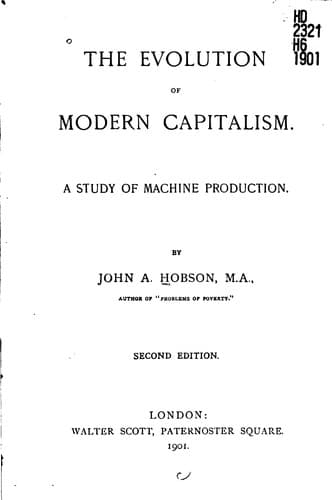
The Evolution of Modern Capitalism: A Study of Machine Production — John Shaqi
The Evolution of Modern Capitalism: A Study of Machine ProductionHobson, J. A. (John Atkinson)
History
The Evolution of Modern Capitalism: A Study of Machine Production
Hobson, J. A. (John Atkinson)
Capitalism; Industries -- History; Machinery in the workplace
In the middle of last century there were very few instances of a
manufacturing business in which a large capital was engaged, or in
which the capital stood to the labour in anything like modern
proportion. It was indeed the merchant and not the manufacturer who
represented the most advanced form of Capitalism in the eighteenth
century. Long before Dr. Johnson's discovery that "an English merchant
is a new species of gentleman," Defoe had noted the rise of
merchant-princes in the Western clothing trades, observing that "many
of the great families who now pass for gentry in these counties have
been originally raised from and built out of this truly noble
manufacture."[52] These wealthy _entrepreneurs_ were sometimes spoken
of as "manufacturers," though they had no claim either upon the old or
the new signification of that name. They neither wrought with their
hands nor did they own machinery and supervise the labour which worked
with it. They were, as has been shown above, merchant-middlemen. The
clothing trade being the most highly developed, evolved several
species of middlemen, including under that term all collectors and
distributors of the raw material or finished goods.
(_a_) One important class of "factors" engaged themselves in buying
wool from farmers and selling it to clothiers, and appear to have
sometimes exercised an undue and tyrannous control over the latter by
an unscrupulous manipulation of the credit system which was growing up
in trade.[53]
(_b_) The "clothiers" themselves must be regarded in large measure as
middleman-collectors, analogous in function to the distributors, who
still rank as one of the grades of middlemen in the cheap clothing
trade of London to-day.[54]
(_c_) After the cloth was made three classes of middlemen were engaged
in forwarding it to the retailer--(1) travelling merchants or
wholesale dealers who attended the big fairs or the markets at Leeds,
Halifax, Exeter, etc., and made large purchases, conveying the goods
on pack-horses over the country to the retail trader; (2) middlemen
who sold on commission through London factors and warehousemen, who in
their turn disposed of the goods to shopkeepers or to exporters; (3)
merchants directly engaged in the export trade.
Public-domain text, read in full here on John Shaqi.
Reviews
Reviews
No reviews yet
Be the first to share your thoughts on this work.
Join the Discussion
Join the discussion
Sign in to leave a comment or review.
Sign InorCreate an account