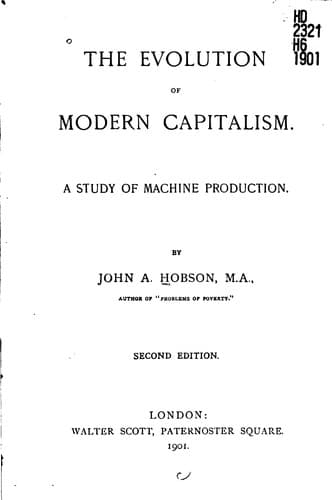
The Evolution of Modern Capitalism: A Study of Machine Production — John Shaqi
The Evolution of Modern Capitalism: A Study of Machine ProductionHobson, J. A. (John Atkinson)
History
The Evolution of Modern Capitalism: A Study of Machine Production
Hobson, J. A. (John Atkinson)
Capitalism; Industries -- History; Machinery in the workplace
With the exception of shipping and canal transport (which became
important after the middle of the century) there were no considerable
industries related to manufacture where large capitals were laid down
in fixed plant. Even the capital sunk in permanent improvements of
land, which played so important a part in the development of
agriculture, belonged chiefly to the latter years of the eighteenth
century. Almost the only persons who wielded large capitals within the
country were those merchants, dealers, or middlemen, whose capital at
any given time consisted of a large stock of raw material or finished
goods. Even the latter were considerably restricted in the magnitude
of their transactions by the imperfect development of the machinery of
finance and the credit system. In 1750 there were not more than twelve
bankers' shops out of London.[55] Until 1759 the Bank of England
issued no notes of less value than £20.
Joint-ownership of capital and effective combination of the labour
units in a business were only beginning to make progress. The Funded
Debt, the Bank of England, the East India Company were the only
examples of really large and safe investments at the opening of the
eighteenth century. Joint-ownership of large capitals for business
purposes made no great progress before the middle of the eighteenth
century, except in the case of chartered companies for foreign trade,
such as the East India Company, the Hudson's Bay Company, the Turkish,
Russian, Eastland, and African companies. Insurance business became a
favourite form of joint-stock speculation in the reign of George I.
The extraordinary burst of joint-stock enterprise culminating in the
downfall of the South Sea Company shows clearly the narrow limitations
for sound capitalist co-operation. Even foreign trade on joint-stock
lines could only be maintained successfully on condition that the
competition of private adventurers was precluded.
Joint-capital had yet made no inroad into manufacture, one of the
earliest instances being a company formed in 1764 with a capital of
£100,000 for manufacturing fine cambrics.[56]
The limits of co-operative capitalism at the opening of the period of
Industrial Revolution are indicated by Adam Smith in a passage of
striking significance:--"The only trades which it seems possible for a
joint-stock company to carry on successfully, without an exclusive
privilege, are those of which all the operations are capable of being
reduced to what is called a routine, or to such a uniformity of method
as admits of little or no variation. Of this kind is, first, the
banking trade; secondly, the trade of insurance from fire and from sea
risk and capture in time of war; thirdly, the trade of making and
maintaining a navigable cut or canal; and fourthly, the similar trade
of bringing water for the supply of a great city."[57]
Public-domain text, read in full here on John Shaqi.
Reviews
Reviews
No reviews yet
Be the first to share your thoughts on this work.
Join the Discussion
Join the discussion
Sign in to leave a comment or review.
Sign InorCreate an account