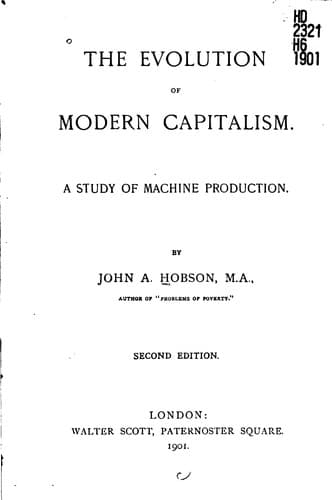
The Evolution of Modern Capitalism: A Study of Machine ProductionHobson, J. A. (John Atkinson)
History
The Evolution of Modern Capitalism: A Study of Machine Production
Hobson, J. A. (John Atkinson)
Capitalism; Industries -- History; Machinery in the workplace
§ 1. Science is ever becoming more and more historical in the sense
that it becomes more studiously anxious to show that the laws or
principles with whose exposition it is concerned not merely are
rightly derived from observation of phenomena but cover the whole
range of these phenomena in the explanation they afford. So likewise
History is ever becoming more scientific in the sense that facts or
phenomena are so ordered in their setting as to give prominence to the
ideas or principles which appear to relate them and of which they are
the outward expression. Thus the old sharp line, of distinction has
slipped away, and we see there is no ultimate barrier between a study
of facts and a study of the laws or principles which dominate these
facts. In this way the severance of History and Science becomes less
logically justifiable. Yet it is still convenient that we should say
of one branch of study that it is historical in the sense that it is
directly and consciously engaged in the collection and clear
expression of facts or phenomena as they stand objectively in place or
time without any conscious reference to the laws which relate or
explain them; of another branch of study that it is scientific because
it is engaged in the discovery, formulation, and correct expression of
the laws according to which facts are related, without affecting to
give a full presentment of those facts. The treatment in this book
belongs in this sense to economic science rather than to industrial
history as being an endeavour to discover and interpret the laws of
the movement of industrial forces during the period of the eighteenth
and nineteenth centuries.
It cannot, however, be pretended that any high degree of exactitude
can attach to such a scientific study.
Two chief difficulties beset any attempt to explain industrial
phenomena by tracing the laws of the action of the forces manifested
in them. The first is that only a limited proportion of the phenomena
which at any given time constitute Industry are clearly and definitely
ascertainable, and it may always be possible that the laws which
satisfactorily explain the statical and dynamical relations of these
may be subordinate or even counteracting forces of larger movements
whose dominance would appear if all parts of the industrial whole were
equally known.
The second difficulty, closely related to the first, is the inherent
complexity of Industry, the continual and close interaction of a
number of phenomena whose exact size and relative importance is
continually shifting and baffles the keenest observer.
These difficulties, common to all sciences, are enhanced in
sociological sciences by the impossibility of adequate experiment in
specially prepared environments.
Public-domain text, read in full here on John Shaqi.
Reviews
Reviews
No reviews yet
Be the first to share your thoughts on this work.
Join the Discussion
Join the discussion
Sign in to leave a comment or review.
Sign InorCreate an account