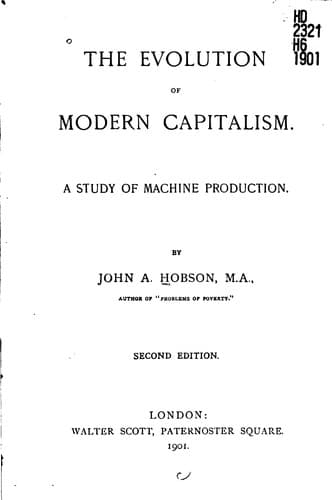
The Evolution of Modern Capitalism: A Study of Machine ProductionHobson, J. A. (John Atkinson)
History
The Evolution of Modern Capitalism: A Study of Machine Production
Hobson, J. A. (John Atkinson)
Capitalism; Industries -- History; Machinery in the workplace
The degree of exactitude attainable in industrial sciences may thus
appear to be limited by the development of statistical inquiry. Since
the collection of accurate statistics, even on those matters which are
most important, and which lend themselves most easily to statistical
description, is a modern acquirement which has not yet widely spread
over the whole world, while the capacity for classifying and making
right use of statistics is still rarer, it is held by some that in a
study where so much depends upon accurate statements of quantity
little advance is at present possible.
And it is, of course, true that until the advance of organised
curiosity has provided us with a complete measurement of industrial
phenomena over a wide area of commerce and over a considerable period
of time, the inductive science of Economics cannot approach
exactitude.
But a study which cannot claim this exactness may yet be a science,
and may have its value. A hypothesis which best explains the generally
apparent relation between certain known phenomena is not the less
science because it is liable to be succeeded by other hypotheses which
with equal relative accuracy explain a wider range of similar
phenomena. It is true that in studies where we know that there exists
a number of unascertained factors we shall expect a more fundamental
displacement of earlier and more speculative hypotheses than in
studies where we know, or think we know, that most of the phenomena
with which we are concerned are equally within our ken: but the
earlier scientific treatment, so far as it goes, is equally necessary
and equally scientific.
In modern industrial changes many different factors, material and
moral, are discernibly related to one another in many complex ways.
According as one or other of the leading factors is taken for a
scientific objective the study assumes a widely different character.
For example, since the end of Industry is wealth for consumption it
would be possible to group the industrial phenomena accordingly as
they served more fully and directly to satisfy human wants, or as they
affected quantitatively or qualitatively the standard of consumption,
and to consider the reflex actions of changed consumption upon modes
of industrial activity. Or again, considering Industry to consist
essentially of organised productive human effort, those factors most
closely related to changes in nature, conditions, and intensity of
work might form the centre of scientific interest; and we might group
our facts and forces according to their bearing upon this. These
points of view would give us different objective scientific studies.
Public-domain text, read in full here on John Shaqi.
Reviews
Reviews
No reviews yet
Be the first to share your thoughts on this work.
Join the Discussion
Join the discussion
Sign in to leave a comment or review.
Sign InorCreate an account