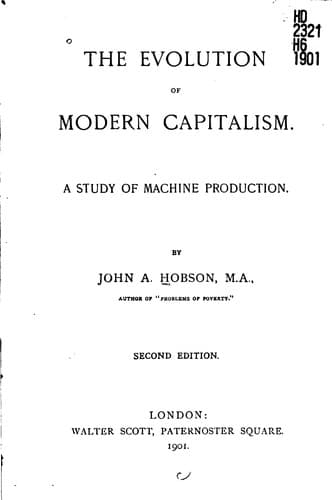
The Evolution of Modern Capitalism: A Study of Machine ProductionHobson, J. A. (John Atkinson)
History
The Evolution of Modern Capitalism: A Study of Machine Production
Hobson, J. A. (John Atkinson)
Capitalism; Industries -- History; Machinery in the workplace
[69] The important part which the cotton and iron industries play in
the export trade of England entitles them to special consideration as
representatives of world-industry. Out of £263,530,585 value of
English exports in 1890, cotton comprised £74,430,749; iron and steel,
£31,565,337.
[70] Cunningham, chap. ii. p. 450.
[71] Schulze-Gaevernitz, _Der Grossbetrieb_, p. 34.
[72] Ure, _The Cotton Manufacture_, p. 187.
[73] Modern economy now favours the specialisation of a factory and
often of a business in a single group of processes--_e.g._, spinning
or weaving or dyeing, both in the cotton and woollen industries. This,
however, is applicable chiefly to the main branches of textile work.
In minor branches, such as cotton thread, the tendency is still
towards an aggregation of all the different processes under a single
roof, both in England and in the United States.
[74] P.R. Hodge, civil engineer--evidence before House of Lords
Committee in 1857.
In Germany a spinning-wheel had been long in use for flax-spinning,
which in effect was an anticipation of the throstle (cf. Karmarch,
_Technologie_, vol. ii. p. 844, quoted Schulze-Gaevernitz, p. 30), and
machine-weaving is said to have been discovered in Danzig as early as
1579.
[75] Cf. Brentano, _Uber die Ursachen der heutigen socialen Noth; Der
Grossbetrieb_, p. 30.
[76] Porter, _Progress of the Nation_, p. 219.
[77] Selected from Porter, p. 218.
[78] In 1824 Mr. Huskisson introduced the principle of free trade,
securing a reduction of the duties on raw and thrown silks, and in
1825, 1826, considerable further reductions were made. (Cf. Ure,
_Philosophy of Manufactures_, p. 454, etc.) But protection of English
silk manufactured goods was maintained until the French Treaty of
1860.
[79] Cf. Ure, _History of the Cotton Manufacture_, vol. i. p. 223.
[80] Scrivener, _History of the Iron Trade_, p. 56.
[81] Cooke Taylor, _Modern Factory System_, p. 164; cf. also Karl
Marx, _Capital_, p. 381.
[82] Schulze-Gaevernitz, p. 140.
[83] Yeats, _The Growth and Vicissitudes of Commerce_, p. 284.
[84] The average income for England in 1688 he puts at £7 18s; for
Holland, £8 1s. 4d.; France, £6--p. 47. Such an estimate, however, has
little value.
[85]
In 1810 the total produce was 140,000 tons.
" 1818 " " " 114,000 "
" 1824 " " " 164,000 "
(Scrivener, _History of the Iron Trade_, p. 153.)
[86] Yeats, _Growth and Vicissitudes of Commerce_, p. 285.
[87] Schulze-Gaevernitz, _Der Grossbetrieb_, p. 48.
[88] Ellison, _History of the Cotton Trade_, presents the following
interesting table (yarn, 40 hanks to the lb.):--
1779. 1784. 1799. 1812. 1830. 1882.
s. d. s. d. s. d. s. d. s. d. s. d.
Public-domain text, read in full here on John Shaqi.
Reviews
Reviews
No reviews yet
Be the first to share your thoughts on this work.
Elsewhere in the archive
Join the Discussion
Join the discussion
Sign in to leave a comment or review.
Sign InorCreate an account