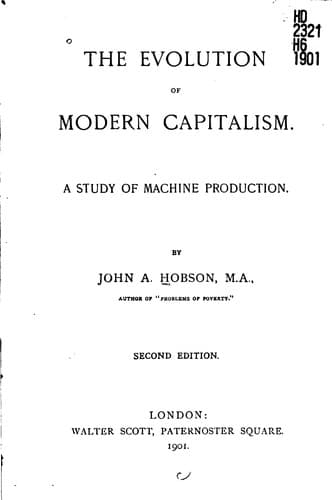
The Evolution of Modern Capitalism: A Study of Machine Production — John Shaqi
The Evolution of Modern Capitalism: A Study of Machine ProductionHobson, J. A. (John Atkinson)
History
The Evolution of Modern Capitalism: A Study of Machine Production
Hobson, J. A. (John Atkinson)
Capitalism; Industries -- History; Machinery in the workplace
Or, once more, taking a purely subjective standpoint, we might search
out the intellectual expression of these industrial changes in the
changing thought and feeling of the age, tracing the educative
influences of industrial development upon (1) the deliberate judgments
of the business world and of economic thinkers as reflected in
economic writings; (2) politics, literature, and art through the
changes of social environment, and the direct stimulation of new ideas
and sentiments. The deeper and more important human bearings of the
changes in industrial environment might thus be brought into
prominence as well as the reaction by which, through the various
social avenues of law, public opinion, and private organised activity,
these intellectual forces have operated in their turn upon the
industrial structure.
The crowning difficulty of an adequate scientific treatment consists in
the fact that each and all of these scientific objects ought to be
pursued simultaneously; that is to say, the whole of the
phenomena--industrial, intellectual, political, moral, æsthetic--should
be presented in their just but ever-changing proportions.
This larger philosophic treatment is only named in order that it may
be realised how narrow and incomplete would be even the amplest
fulfilment of the purpose indicated in the title of this book.
§ 2. Industrial science has not yet sufficiently advanced to enable a
full treatment of the objective phenomena to be attempted.
The method here adopted is to take for our intellectual objective one
important factor in modern industrial movements, to study the laws of
its development and activity, and by observing the relations which
subsist between it and other leading factors or forces in industry to
obtain some clearer appreciation and understanding of the structure of
industry as a whole and its relation to the evolution of human
society. This central factor is indicated by the descriptive title
peculiarly applied to modern industry, Capitalism. A clear view of the
phenomena grouped together under the head of the Industrial Revolution
cannot fail to give prominence to the changes that have taken place in
the structure and functional character of Capital. Whatever
transformations have taken place in the character of land, the raw
material of industrial wealth, and of labour, or those abilities and
faculties of man which operate upon the raw material, have occurred
chiefly and directly through the agency of the enlarged and more
complex use of those forms of material wealth which, while embodying
some element of human effort, are not directly serviceable in
satisfying human want.
Public-domain text, read in full here on John Shaqi.
Reviews
Reviews
No reviews yet
Be the first to share your thoughts on this work.
Join the Discussion
Join the discussion
Sign in to leave a comment or review.
Sign InorCreate an account