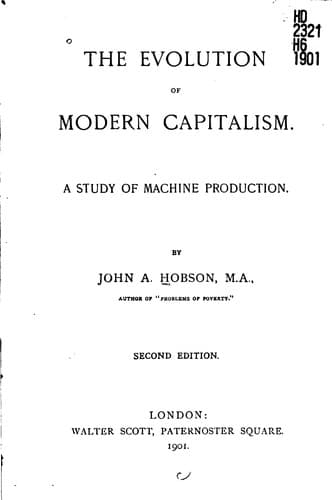
The Evolution of Modern Capitalism: A Study of Machine ProductionHobson, J. A. (John Atkinson)
History
The Evolution of Modern Capitalism: A Study of Machine Production
Hobson, J. A. (John Atkinson)
Capitalism; Industries -- History; Machinery in the workplace
people and goods between places were private, slow, and infrequent, to
times when there began to run at intervals of several days public
vehicles moving at four miles an hour, and then to times when these
shortened their intervals and increased their speed, while their lines
of movement multiplied, ending in our own times, when along each line
of rails there go at full speed a dozen waves daily that are
relatively vast, sufficiently show us how the social circulation
progresses from feeble, slow, irregular movements to a rapid, regular,
and powerful pulse."[116]
The differentiation of function in the several parts of the industrial
organism finds a partial expression in the localisation of certain
industries. As there is growing division of labour among individuals
and groups of individuals, so the expansion of the area of competition
has brought about a larger and larger amount of local specialisation.
Roughly speaking, the West of Europe and of America has specialised in
manufacture, drawing an ever larger proportion of their food supplies
from the North-West States of America, from Russia, the Baltic
Provinces, Australia, Egypt, India, etc., and their raw materials of
manufacture from the southern United States, South America, India,
etc., while these latter countries are subjected to a correspondent
specialisation in agriculture and other extractive arts. If we take
Europe alone, we find certain large characteristics which mark out the
Baltic trade, the Black Sea trade, the Danube trade, the Norwegian and
White Sea trade. So the Asiatic trade falls into certain tolerably
defined divisions of area, as the Levant trade, the Red Sea trade, the
Indian, the Straits, and East Indian, the China trade, etc. The whole
trade of the world is thus divided for commercial purposes.[117]
Though these trade divisions are primarily suggested by
considerations of transport rather than of the character of
production, the geographical, climatic, and other natural factors
which determine convenient lines of transport are found to have an
important bearing on the character of the production, and convenience
of transport itself assists largely to determine the kind of work
which each part of the world sets itself to do.
The establishment of a world-market for a larger and larger number of
commodities is transforming with marvellous rapidity the industrial
face of the globe. This does not now appear so plainly in the more
highly-developed countries of Europe, which, under the influence of
half a century's moderately free competition for a European market,
have already established themselves in tolerably settled conditions of
specialised industry. But in the new world, and in those older
countries which are now fast yielding to the incursions of
manufacturing and transport machinery, the specialising process is
making rapid strides.
Public-domain text, read in full here on John Shaqi.
Reviews
Reviews
No reviews yet
Be the first to share your thoughts on this work.
Elsewhere in the archive
Join the Discussion
Join the discussion
Sign in to leave a comment or review.
Sign InorCreate an account