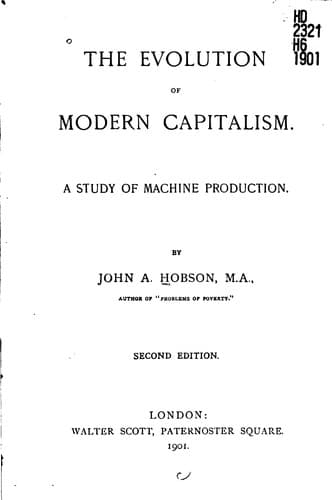
The Evolution of Modern Capitalism: A Study of Machine ProductionHobson, J. A. (John Atkinson)
History
The Evolution of Modern Capitalism: A Study of Machine Production
Hobson, J. A. (John Atkinson)
Capitalism; Industries -- History; Machinery in the workplace
Improved knowledge of the world, facile communication, an immense
increase in the fluidity of capital, and a considerable increase in
that of labour, are busily engaged in distributing the productions of
the world in accordance with certain dominant natural conditions.
Those industrial forces which have during the last century and a half
been operative in England, draining the population and industry from
the Southern and Eastern counties, and concentrating it in larger
proportions in Lancashire, the West Riding, Staffordshire, and round
the Northumbrian and South Wales coal-fields, specialising each town
or locality upon some single branch of the textile, metal, or other
industries for which its soil, position, or other natural advantages
made it suitable, are now beginning to extend the area of their
control over the whole surface of the known and inhabited globe.
As large areas of Asia, South and Central Africa, Australia, and South
America fall under the control of European commercial nations, are
opened up by steamships, railways, telegraphs, and are made free
receptacles for the increased quantity of capital which is unable to
find a safe remunerative investment nearer home, we are brought nearer
to a condition in which the whole surface of the world will be
disposed for industrial purposes by these same forces which have long
been confined in their direct and potent influence to a small portion
of Western Europe and America. This vast expansion of the area of
effective competition is beginning to specialise industry on the basis
of a world-market, which was formerly specialised on the more confined
basis of a national or provincial market. So in England, where the
early specialisation of machine-industry was but slightly affected by
outside competition, great changes are taking place. Portions of our
textile and metal industries, which naturally settled in districts of
Lancashire, Yorkshire, and Staffordshire, while the area of
competition was a national one,[118] seem likely to pass to India, to
Germany, or elsewhere, now that a tolerably free competition on the
basis of world-industry has set in. It is inevitable that with every
expansion of the area of competition under which a locality falls the
character of its specialisation will change. A piece of English ground
which was devoted to corn-growing when the market was a district one
centred in the county town, becomes the little factory town when
competition is established on a national basis; it may become the
pleasure-ground of a retired millionaire speculator if under the
pressure of world-competition it has been found that the manufacture
which now thrives there can be carried on more economically in Bombay
or Nankin, where each unit of labour power can be bought at the
cheapest rate, or where some slight saving in the transport of raw
material may be effected.
Public-domain text, read in full here on John Shaqi.
Reviews
Reviews
No reviews yet
Be the first to share your thoughts on this work.
Elsewhere in the archive
Join the Discussion
Join the discussion
Sign in to leave a comment or review.
Sign InorCreate an account