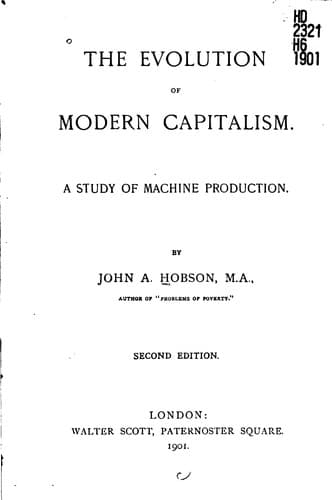
The Evolution of Modern Capitalism: A Study of Machine ProductionHobson, J. A. (John Atkinson)
History
The Evolution of Modern Capitalism: A Study of Machine Production
Hobson, J. A. (John Atkinson)
Capitalism; Industries -- History; Machinery in the workplace
§ 10. The question how industry would be located, assuming the whole
surface of the globe was brought into a single market or area of
competition, with an equal development of transport facilities in all
its parts; or in other words, "What is the ideal disposition of
industry in a world-society making its chief end the attainment of
industrial wealth estimated at present values?" is one to which of
course no very exact answer can be given. But since this ideal
represents the goal of modern industrial progress, it is worth while
to call attention to the chief determinants of the localisation of
industries under free world-competition. The influences may be placed
in three groups, which are, however, interrelated at many points.
(1) The first group may be called Climatic, the chief influences of
which are astronomical position, surface contour, prevalent winds,
ocean currents, etc. Climatic zones have their own flora and fauna,
and so far as these enter into industry as agricultural and pastoral
produce, as raw materials of manufacture, as sustenance of labour,
they are natural determinants of the localisation of industry. In
vegetable products the climatic zones are very clearly marked. "The
boreal zone has its special vegetation of mosses, lichens, saxifrages,
berries, oats, barley, and rye; the temperate zone its peas, beans,
roots, hops, oats, barley, rye, and wheat; this zone, characterised by
its extent of pastures, hop gardens, and barley fields, has also a
distinctive title in the 'beer and butter region.' The warm temperate
zone, or region of 'wine and oil,' is characterised by the growth of
the vine, olive, orange, lemon, citron, pomegranate, tea, wheat,
maize, and rice; the sub-tropical zone, by dates, figs, the vine,
sugar-cane, wheat, and maize; the tropical zone is characterised by
coffee, cocoa-nut, cocoa, sago, palm, figs, arrowroot, and spices; and
the equatorial by bananas, plantains, cocoa-nut, etc."[119]
(2) The second group is geographical and geological. The shape and
position of a country, its relation in space to other countries, the
character of the soil and sub-soil, its water-supply, though closely
related to climatic influences, have independent bearings. The
character of the soil, which provides for crops their mineral food,
has an important bearing upon the raw materials of industry. The shape
and position of the land, especially the configuration of its coast,
have a social as well as climatic significance, directing the
intercourse with other lands and the migrations of people and
civilisations which play so large a part in industrial history.
Public-domain text, read in full here on John Shaqi.
Reviews
Reviews
No reviews yet
Be the first to share your thoughts on this work.
Elsewhere in the archive
Join the Discussion
Join the discussion
Sign in to leave a comment or review.
Sign InorCreate an account