The evolution of worlds from nebulaeDean, Lee Parker
Science
The evolution of worlds from nebulae
Dean, Lee Parker
Nebular hypothesis
Transcriber’s Note
Italic text displayed as: _italic_
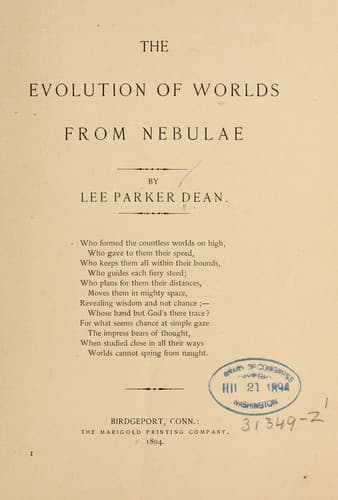
THE
EVOLUTION OF WORLDS
FROM NEBULAE
BY
LEE PARKER DEAN.
Who formed the countless worlds on high,
Who gave to them their speed,
Who keeps them all within their bounds,
Who guides each fiery steed;
Who plans for them their distances,
Moves them in mighty space,
Revealing wisdom and not chance;—
Whose hand but God’s there trace?
For what seems chance at simple gaze
The impress bears of thought,
When studied close in all their ways
Worlds cannot spring from naught.
BRIDGEPORT, CONN.:
THE MARIGOLD PRINTING COMPANY.
1894.
Copyright.
LEE PARKER DEAN.
1894.
TO THE LOVED PARENTS AND AUNT WHO WATCHED OVER US IN THE DAYS OF OUR
CHILDHOOD, AND ARE NOW CHANGED FROM MORTAL TO IMMORTAL, THIS VOLUME IS
AFFECTIONATELY INSCRIBED.
L. P. D.
TO THE READER.
THE AUTHOR SENDS OUT THIS LITTLE BOOK FEELING THAT IF THEREBY HE HAS
MADE MORE CLEAR THE UNSEEN HAND THAT EVOLVED AND STILL CONTROLS THE
UNIVERSE HE WILL BE AMPLY REWARDED.
L. P. D.
BRIDGEPORT, JUNE, 1894.
THE EVOLUTION OF WORLDS FROM NEBULAE.
INTRODUCTION.
The theory of world-formation as conceived by the Nebular hypothesis
has been briefly stated by Dr. H. W. Warren in the following words:
“All the matter composing all the bodies of the sun, planets, and their
satellites, once existed in an exceedingly diffused state; rarer than
any gas with which we are acquainted, filling a space larger than the
orbit of Neptune. Gravitation gradually contracted this matter into
a condensing globe of immense extent. Some parts would naturally be
denser than others, and in the course of contraction a rotary motion,
it is affirmed, would be engendered. Rotation would flatten the globe
somewhat in the line of its axis.
Contracting still more, the rarer gases, aided by centrifugal force,
would be left behind as a ring that would ultimately be separated, like
Saturn’s ring, from the retreating body. There would naturally be some
places in this ring denser than others; these would gradually absorb
all the ring into a planet, and still revolve about the central mass,
and still rotate on its own axis, throwing off rings from itself.
Public-domain text, read in full here on John Shaqi.
Reviews
Reviews
No reviews yet
Be the first to share your thoughts on this work.
Join the Discussion
Join the discussion
Sign in to leave a comment or review.
Sign InorCreate an account