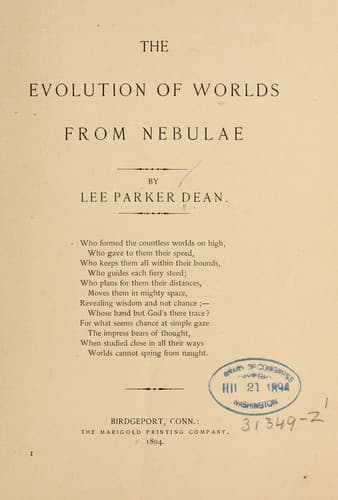
The evolution of worlds from nebulaeDean, Lee Parker
Science
The evolution of worlds from nebulae
Dean, Lee Parker
Nebular hypothesis
Thus the planet Neptune would be left behind in the first sun-ring,
to make its one moon; the planet Uranus left in the next sun-ring;
and so on down to Mercury. The outer planets would cool off first,
become habitable, and, as the sun contracted and they radiated their
own heat, become refrigerated and left behind by the retreating sun.
The four great classes of facts confirmatory of this hypothesis are as
follows: 1st. All the planets move in the same direction and nearly in
the same plane, as if thrown off from one equator; 2d. The motions of
the satellites about their primaries are mostly in the same direction
as that of their primaries about the sun; 3d. The rotation of most
of these bodies on their axes, and also of the sun, is in the same
direction as the motion of the planets about the sun; 4th. The orbits
of the planets, excluding asteroids, and their satellites, have but a
comparatively small eccentricity; 5th. Certain nebulae are observable
which are not yet condensed into solids, but are still bright gas.”[1]
The nebular hypothesis above stated was advanced by astronomers
early in the eighteenth century, and later established by Laplace on
a mathematical basis, who at the same time advocated the theory as
materialistic. It is accepted quite generally by astronomers at the
present day, though in a greatly modified form; for there are many
difficulties in the way of a full belief of the theory. Sir Robert
Ball in a late work says of Herschel’s belief of the transmutation of
nebulae into stars; “To establish this theory it would be necessary
to watch the actual condensation of one single nebula from the
primitive gaseous condition down to the stellar points. It may easily
be conceived that such a process would require a vast lapse of time,
perhaps enormously greater than the period between the invention of the
telescope and the present moment. It may at all events be confidently
asserted that this condensation of a nebula into a star is a process
which has never been witnessed.” Concerning the theory of Laplace
he tells us that it is “almost incapable of receiving any direct
testimony;” and gives as the verdict of science, the words of Newcomb;
“At the present time the nebular hypothesis is only indicated by the
general tendencies of the laws of nature.”
Public-domain text, read in full here on John Shaqi.
Reviews
Reviews
No reviews yet
Be the first to share your thoughts on this work.
Join the Discussion
Join the discussion
Sign in to leave a comment or review.
Sign InorCreate an account