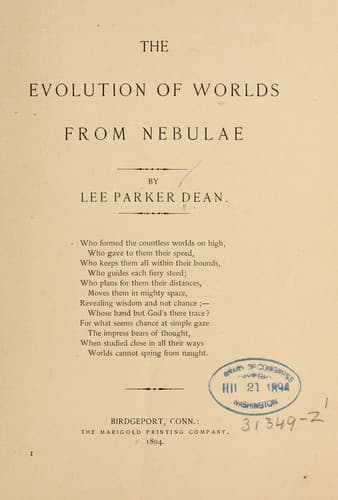
The evolution of worlds from nebulaeDean, Lee Parker
Science
The evolution of worlds from nebulae
Dean, Lee Parker
Nebular hypothesis
Sir Robert S. Ball has given a very marked illustration of the
wonderful magnitude of space in his late book entitled “In the
High Heavens,” from which we quote as follows: “Summon up to your
imagination the most distant star that can be seen with the unaided
eye. Then think of the minutest star that our most potent telescope
can disclose. Think of the tiniest stellar point of light which could
possibly be depicted on the most sensitive photographic plate after
hours of exposure to the heavens. Think, indeed, of the very remotest
star which, by any conceivable device, can be rendered perceptible to
our consciousness. Doubtless that star is thousands of billions of
miles from earth; doubtless the light from it requires thousands of
years, and some astronomers have said millions of years, to span the
abyss which intervenes between our globe and those distant regions.
But, nevertheless, there is a certain number of miles, even though we
know it not, at which the remotest stars known to us must lie. I do not
speak of the most distant star which the universe may possibly contain;
I only refer to the most distant star that we can possibly bring within
our ken.
Imagine a great sphere to be described with its centre at our earth,
and with a radius extending all the way from the earth to this last
star knowable by man. Every star that we can see, every star whose
existence becomes disclosed to us on our photographs, lies inside
this sphere; as to the orbs which may lie outside that sphere we
can know nothing by direct observation. The imagination doubtless
suggests with irresistible emphasis, that this outer region is also
occupied by stars and nebulae, suns and worlds, in the same manner as
the interior of that mighty sphere whose contents are more or less
accessible to our scrutiny. It would do utter violence to our notions
of the law of continuity to assume that all the existent matter in
the universe happened to lie inside this sphere; we need only mention
such a supposition to dismiss it as wholly indefensible. I do not now
make any attempt to express the number of miles in the diameter of the
sphere which limits the extent of space known directly to man. What
that number may be is quite immaterial for our present purpose. But the
point that I especially want to bring out is that the volume occupied
by this stupendous globe, which includes within it all possible visible
material, must be but a speck when compared with the space which
contains it. Think of the water in the Atlantic Ocean, and think of the
water in a single drop. As the drop is to the Atlantic Ocean so is the
sphere which we have been trying to conceive to the boundless extent
of space. As far as we know it would seem that there could be quite
as many of such spheres in space as there are drops of water in the
Atlantic Ocean.”
Public-domain text, read in full here on John Shaqi.
Reviews
Reviews
No reviews yet
Be the first to share your thoughts on this work.
Join the Discussion
Join the discussion
Sign in to leave a comment or review.
Sign InorCreate an account