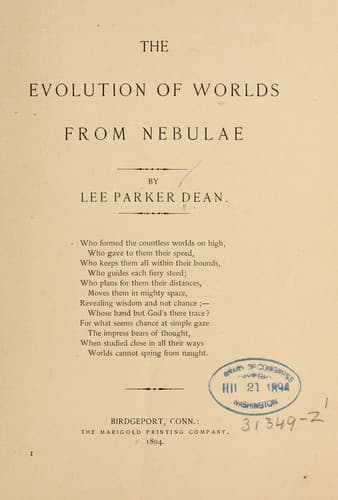
The evolution of worlds from nebulaeDean, Lee Parker
Science
The evolution of worlds from nebulae
Dean, Lee Parker
Nebular hypothesis
If the distance from our sun to the next nearest sun is 20 trillions
of miles, a sphere whose radius reaches half way, that is ten trillion
miles, could contain eight sextillions of suns, each with a diameter
of one million of miles. Now let a single grass seed represent one of
these suns, and twenty-seven millions of them one cubic inch. Should we
fill a bin one mile long, broad, and high, with such seeds, there would
yet be more suns in the above sphere than it would take of grass seeds
to fill this bin holding seven sextillions of them. When we think that
each grass seed is to represent a sun two million times larger than our
earth,—for each sun with a million of miles diameter would,—the thought
of the contents of such a sphere is overwhelming.
Professor Mitchell tells us that with a telescope light from distant
nebulae can be seen that has been thirty millions of years on its
journey. Let us imagine a sphere with a radius of one million years of
light’s flight at the rate of twelve million miles per minute, viz.,
six quintillions of miles. A sphere of such a radius would contain
as many spheres of ten trillions of miles radius as one could put
cubic inches in 850 cubic miles, or 216,000 trillions. This sphere
could hold as many suns of one million miles diameter as there might
be grass seeds that would cover a million of earth’s for one mile in
depth, each earth containing on its surface 200 millions of square
miles, and every cubic inch thereof representing 27 millions of grass
seeds. When we think that each seed represents two millions of earths
can we comprehend the greatness of the universe? Remember the same
calculations that enable us to determine the number of cubic feet in
our earth, sun, or any other sphere, bring these astounding but certain
results. And when we further remember this space is every where so
clear and powerful that it transmits light at the rate of over eleven
million miles each minute, enabling us to see in every part of the
heavens the wonderful stars at an immense distance; and that if we
bring to our aid the most powerful telescopes they only tend to magnify
the already vast number of stars; we are led to realize that beyond
all things else we can conceive space is the most astonishing and
wonderful, excepting its great Creator. While some think that the sun
is cooling and all its planets will be affected thereby, and refer to
the destruction and instability of earthly things; where is there a
single atom of this inconceivably vast, vibratory space that reveals
the least change or destructiveness, although it must have existed for
millions of ages.
Public-domain text, read in full here on John Shaqi.
Reviews
Reviews
No reviews yet
Be the first to share your thoughts on this work.
Join the Discussion
Join the discussion
Sign in to leave a comment or review.
Sign InorCreate an account