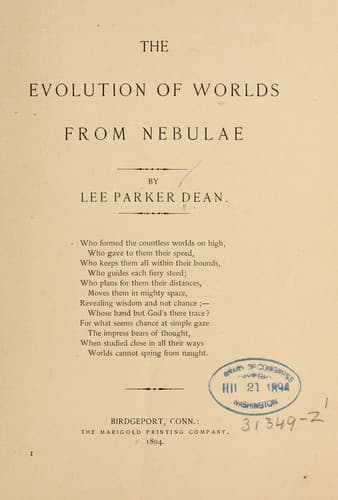
The evolution of worlds from nebulaeDean, Lee Parker
Science
The evolution of worlds from nebulae
Dean, Lee Parker
Nebular hypothesis
In order to better comprehend the mighty vastness of this space we
will measure it again into units of 260,000 millions of cubic miles,
(the size of earth), and with a radius based on the number of miles
of light’s flight in minutes, days, months, and years, ascertain the
number of different sized spheres that such radii would form. A sphere
with earth as its centre, and a radius of one minute of light’s flight,
would contain 21 billions of earths; a sphere whose radius was _nine_
minutes would contain 15,310 billions of earths, one of an hour’s
radius 4,500 trillions, one of a day’s 62 quintillions, a week’s 20
sextillions, a month’s 1675 sextillions, and a year’s radius of the
flight of light three octillions. To go still further; 10 year’s radius
of light’s flight would contain three nonillions, 100 year’s three
decillions, 1,000 year’s three undecillions, 1,000,000 year’s three
quattuordecillions, and a thousand million years radius would contain
three septendecillions of such earths. Now to compare these great
numbers we will suppose, as before, that there are 200 drops of water
in one cubic inch, making 50 quadrillions of drops in one cubic mile of
water, 50 quintillions in one thousand cubic miles, 50 sextillions in
one million of such miles, 50 septillions in one thousand millions, and
50 octillions in one million millions of cubic miles.
We need go no further for the immensity of space is seen by comparison
of the earths in the above spheres with the number of drops of water in
all those cubic miles. We find the sphere that has but one day’s flight
of light as a radius will contain more earths of 260,000 millions of
cubic miles each, than there are water-drops in 1,000 cubic miles; or,
in other words, as many drops as there would be in 100 Sounds like Long
Island from Bridgeport to New York, allowing those sounds to average
100 feet in depth and each contain ten cubic miles of water.
The thought so astounding and well nigh inconceivable is that a sphere
of such vast dimensions has only a radius of a single day’s flight of
light, light that starting from its centre would pass the circumference
of the sphere in one day; while a sphere with a radius of _ten_ year’s
flight of light—a distance only a little way beyond the nearest known
star in the northern heavens, 61 Cygni—could contain as many earths as
there are drops in 60 millions of millions of cubic miles. Yet a sphere
with that radius of ten year’s flight would cover such an enormous
quantity of space as to be beyond our comprehension and still be of
no consequence in comparison with the spheres of one hundred, one
thousand, one million, or one thousand millions of years radii.
Public-domain text, read in full here on John Shaqi.
Reviews
Reviews
No reviews yet
Be the first to share your thoughts on this work.
Join the Discussion
Join the discussion
Sign in to leave a comment or review.
Sign InorCreate an account