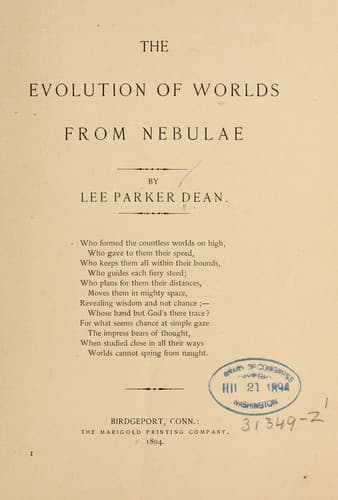
The evolution of worlds from nebulaeDean, Lee Parker
Science
The evolution of worlds from nebulae
Dean, Lee Parker
Nebular hypothesis
Why I thus compute 1,000 millions of years of light’s radius is
because it is possible with powerful telescopes to detect light coming
that distance; and when we contemplate that our nearest star, Alpha
Centauri, is twenty trillions of miles distant, and 61 Cygni more than
twice as far,—or _seven_ year’s flight of light,—and that the Polar
star is some fifty years of light’s flight removed from us; then, if
all suns are no nearer to each other than these are to our sun, we are
led to believe we may see light with our unaided vision that has been
on its journey for a million years. Some detect with the naked eye the
light that comes from the nebula in the Sword’s-Handle of Orion, which
is thought to contain two trillions, two hundred billions of stars;
and if all these stars are no nearer to each other than Alpha Centauri
is to our sun, it cannot be otherwise than that some of them are so
distant their light may have been travelling for a million years before
it comes to our sight. If this be true, with telescopes that penetrate
a thousand times farther into the heavens, we may possibly see light
that has been on its voyage to earth one thousand millions of years.
But the number of earths a sphere of 1,000 millions of years of light’s
flight would contain makes the number of drops of water in sixty
millions of millions of cubic miles (equalling but the earths in a
sphere of _ten_ years radius) sink into utter insignificance. And yet a
sphere of this dimension, even, may be small beside the whole universe
of ether whose every atom in all the millions of years past, as far
as known, has not in the least diminished its wonderful energy; and,
with lightning-like transmission, still brings to our sight light from
distant stars, all of which are so distant that they do not materially
increase the present flow of light. For if but a single one were to
come between us and the sun the increase of that light and heat would
be unendurable.
Public-domain text, read in full here on John Shaqi.
Reviews
Reviews
No reviews yet
Be the first to share your thoughts on this work.
Join the Discussion
Join the discussion
Sign in to leave a comment or review.
Sign InorCreate an account