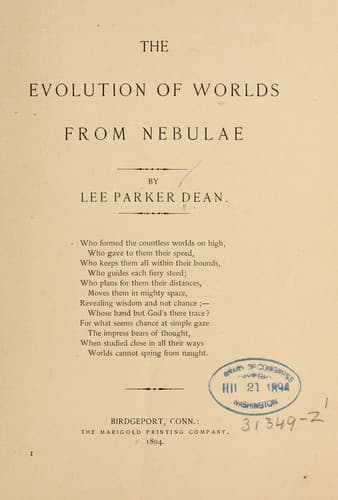
The evolution of worlds from nebulaeDean, Lee Parker
Science
The evolution of worlds from nebulae
Dean, Lee Parker
Nebular hypothesis
That the heat of the earth increases as we penetrate its surface has
been learned from mining, tunneling, and the boring of wells. Yet on
testing the wells they do not seem to show any uniform temperature.
The deepest Artesian well is in St. Louis and has a depth of 3,843½
feet, while its water is found to be of a temperature of 105°.[14] This
would seem to indicate that the earth is hotter as we descend into
it; still, there may be reasonable causes therefore without its heat
extending after all to any great depth. When we remember that the earth
is 4,000 miles from surface to centre we find that this deep well is
not even 1/5000 part of the distance, and what may be in the interior
of the earth is yet quite uncertain. It may possess elements, that from
earth’s swift revolutions on its axis, and far swifter flight through
space, would supply any loss of heat over and above what is received
from the sun. Heat may also penetrate earth’s surface more easily than
it escapes, for earth is surrounded by an atmosphere that receives
the sunlight readily, but not so readily lets it go; and prevents the
outside cold of 200° below zero from falling upon it nightly.
Further it is said, with seeming reasonableness; “No rock has the
requisite rigidity to resist the crushing weight of a mountain twenty
miles high.” Whatever movements may take place in the earth’s crust,
involve masses so great and forces so enormous that the resistances
of ordinary matter are inconsiderable. The most solid rocks are
essentially fluid or viscid. Now, such movements must necessarily
result from two causes: First, a slow shrinkage of the earth through
loss of heat; secondly, the attraction of the sun and moon, which cause
tidal protuberances on the surface of the earth, however rigid it may
be; and these, continually shifting their positions, as the oceanic
tides do, result in daily motions adequate to develop a large amount of
frictional heat.[15]
Public-domain text, read in full here on John Shaqi.
Reviews
Reviews
No reviews yet
Be the first to share your thoughts on this work.
Join the Discussion
Join the discussion
Sign in to leave a comment or review.
Sign InorCreate an account