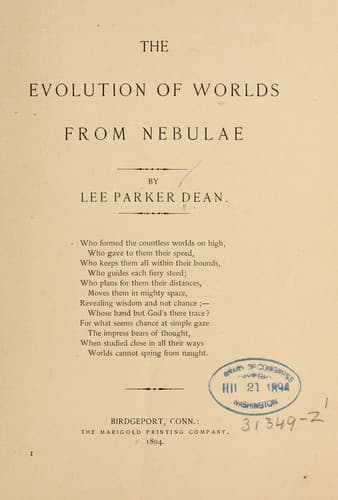
The evolution of worlds from nebulaeDean, Lee Parker
Science
The evolution of worlds from nebulae
Dean, Lee Parker
Nebular hypothesis
When we remember that the Mesozoic aeon was preceded by the long
Palæozoic, and earlier by the Eozoic,—whose aeon has been laid down
at eleven million years, with a strata at least 50,000 feet thick of
hardest rock,—what could have been the cause of the submerging of the
lands where these gases and coal lay? For millions of years the Eozoic
strata had upheld the oceans that were two or more miles in depth, and
of enormous weight. If the earth was cooling all those years the crust
must have been hardening, and what added weight could have been at
so late a period to cause the submerging of those lands? It has been
thought that in the glacial period when the accumulation of ice over a
portion of earth’s surface lay 5,000 feet thick that its weight might
have depressed the terrestrial crust.[13] But ice being lighter than
water, even though it were of that thickness, would not have had the
weight of water a mile in depth; whereas more than twice that depth of
water rested upon three-fourths of the globe. Moreover the ice-period
was many millions of years later than the Palæozoic and Eozoic ages,
and had the earth all this time been growing colder its crust must have
been thickening, making it capable of enduring almost any pressure. Any
crust, as ice upon water or the shell upon an egg, will bear more than
its whole weight before it will sink into the substance upon which it
rests.
It might be thought that earth, while cooling, would shrink beneath its
crust and leave a vacuum, as ice sometimes does upon a small surface.
This could not happen as the vast surface of extended crust, by the
enormous pressure of air upon it, would be held closely pressed to
whatever was beneath. For, although earth’s surface is convex, it is
still 25,000 miles around it, a distance so great that its crust would
have almost the same pressure as if the surface were level.
FOOTNOTES:
[12] Winchell, “Walks and Talks in the Geological Field,” p. 99.
[13] Winchell, “Walks and Talks in the Geological Field,” p. 275.
CHAPTER VI.
THE EARTH’S HEAT.
Public-domain text, read in full here on John Shaqi.
Reviews
Reviews
No reviews yet
Be the first to share your thoughts on this work.
Join the Discussion
Join the discussion
Sign in to leave a comment or review.
Sign InorCreate an account