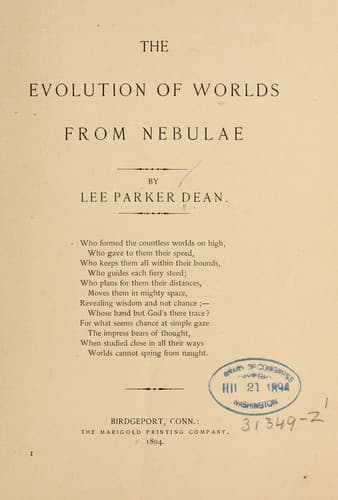
The evolution of worlds from nebulaeDean, Lee Parker
Science
The evolution of worlds from nebulae
Dean, Lee Parker
Nebular hypothesis
The petroleum, natural gas, and coal that have been little known until
the last fifty years, are all lying within one half mile of earth’s
surface and of sufficient quantity to make several volcanoes, could
oxygen be brought to fan them into a flame. What materials equally as
combustible may be discovered when the earth is penetrated in other
places, and for another half mile below its surface, we do not know;
neither do we know what may be revealed as we descend deeper and deeper
into earth’s every portion until reaching a depth of an hundred or a
thousand miles. But who shall say there are not as wondrous things yet
to come from beneath earth’s crust as have ever been found upon, or
near, its surface? Man has already discovered over sixty elements some
of which, were they in abundance, would give a very enduring flame.
When we see chemists separating water for burning, or consuming steel
files in combustion we may be prepared for other startling discoveries.
What we already know, through cyclones and hurricanes, concerning the
power of air, that is seemingly so subtle and still, should lead us to
believe that we have as yet little understanding relative to the hidden
truths of earth; and what its interior may possess of heat and other
elements is not for us to say with any degree of certainty.
The thought we may now well entertain is this; it is remarkable that
the earth’s surface where we are dwelling is well adapted for our
existence. At present there is life here; that death was in the past,
and destruction will be in the future, we may believe as we choose, but
have no certainty of the fact; for the indestructibleness of every atom
of ether in the universe would seemingly question the power of time to
work destruction to our earth so minute in comparison.
[Illustration: Decoration]
FOOTNOTES:
[14] Winchell, “Walks and Talks in the Geological Field,” p. 98.
[15] Winchell, “Walks and Talks in the Geological Field,” p. 101.
[16] Winchell, “Walks and Talks in the Geological Field,” p. 99.
CHAPTER VII.
THE SUN’S LIGHT AND HEAT.
I conceive that one reason why scientists believe in the nebular
hypothesis is because of their knowing that heat consumes. One cannot
contemplate a burning object without perceiving that it grows smaller
and smaller; therefore why should not the sun with its flaming
hydrogen, rising sometimes to a height of 200,000 miles, consume the
sun? It is claimed but 1/2300 millionth of its force reaches earth,
and yet it is asserted that the sun could melt 287,200,000 cubic miles
of ice per second without quenching its heat.[17] From what we know
appertaining to heat, how can we think it is otherwise than reducing
the sun’s volume?
Public-domain text, read in full here on John Shaqi.
Reviews
Reviews
No reviews yet
Be the first to share your thoughts on this work.
Join the Discussion
Join the discussion
Sign in to leave a comment or review.
Sign InorCreate an account