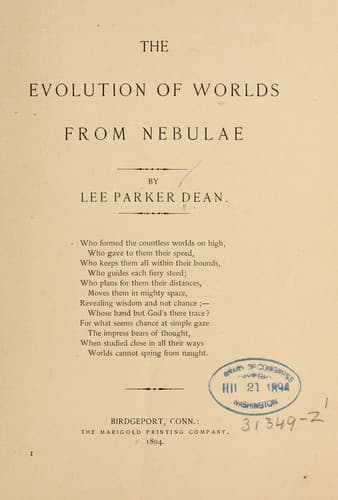
The evolution of worlds from nebulaeDean, Lee Parker
Science
The evolution of worlds from nebulae
Dean, Lee Parker
Nebular hypothesis
Yet we must remember there are other things as difficult of
comprehension. We see the mist rising from the ocean and forming into
clouds that drift through the heavens when moved by the winds, and we
might well believe in future years the oceans will be drained of their
contents. But when we learn that all those waters pass into the sky but
to condense and fall to earth, and then through streams again reach the
oceans, we can readily understand that they may be the same to-day as
when created; nor conceive how it will be otherwise to the end of time.
Again, when a boiler of water seems wasting through invisible steam,
expanded 1800 times its original bulk, we might well believe it is
being destroyed only we have learned all that steam in some manner
cools and forms again the first element H^2 O, not one particle being
lost. When any body is burned and we see the flames ascending into the
air, we say it is being destroyed, for so it seems; but chemists tell
us the form alone is changed and the weight after burning identical
with its first weight; showing thereby that not one particle of earth
can either be formed or destroyed, but simply changed from combinations
of molecules to simple molecules, or _vice-versa_.
We see earth everywhere surrounded by an atmospheric sea, not of oxygen
and hydrogen, but of oxygen and nitrogen—four-fifths being nitrogen—and
were the other fifth the same no life could exist in it. Scientists
tell us this atmosphere extends from one to two hundred miles into the
sky, but is densest at the earth’s surface; and as one ascends rapidly
rarifies so that at a height of a few miles no life can exist. From
what is known of winds and cyclones one might expect the atmosphere
would be torn from earth, especially as earth moves at the rate of
1100 miles per minute, and revolves on its axis about the same number
of miles per hour. One would suppose, at least, that which is highest
and thinnest must be left behind in space; yet we cannot learn since
Earth’s creation that any of it has been thus lost.
Public-domain text, read in full here on John Shaqi.
Reviews
Reviews
No reviews yet
Be the first to share your thoughts on this work.
Join the Discussion
Join the discussion
Sign in to leave a comment or review.
Sign InorCreate an account