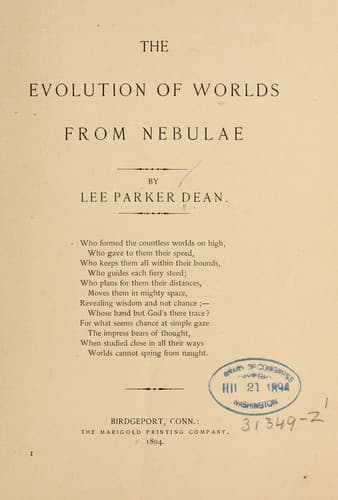
The evolution of worlds from nebulaeDean, Lee Parker
Science
The evolution of worlds from nebulae
Dean, Lee Parker
Nebular hypothesis
If it is true that earth receives but a portion of the fearful hydrogen
heat that flames in the sun’s photosphere, one-half being restrained
that it does not reach the earth, may not the rest as easily be
withheld in the far distant space and lie within the sun’s power of
gravitation?
While the sun is the light and heat of earth and all the planets and
their satellites,—as a mother caring for her children,—may not all
these planets, with their atmospheres and powers of gravitation,
help return to her what she so freely bestows upon them? Is it more
difficult to believe this than that we are daily using heat stored for
ages in earth by this same wondrous sun whose light and heat, if more
or less, would work the destruction of man?
When we think of the hundreds of millions of years ago that Saturn and
Jupiter were a portion of the sun’s body we should, according to the
nebular theory, expect that those bodies would long since have cooled.
But if Saturn is to-day a hot, gaseous body of not one-thousandth
part the sun’s mass, nor of an equal density with it, how does it
happen that it is not cold? As astronomers cannot tell the years it
may continue thus hot possibly there may be something about light and
heat that is not yet understood? We are told by Dr. Huggins: “The green
coronal line has no known representative in terrestrial substances, nor
has Schuster been able to recognize any of our elements in the other
lines of the corona.”
It has been said that “the sun cannot shine forever;” why not? Let us
imagine two persons in a room making an agreement that thereafter but
one of them shall be in the room at the same time, for as one enters
it the other will immediately leave. This they might agree to do every
hour, day, year, or millions of years even, could they exist here, and
thus keep it up forever. Likewise if the sun’s rays in some manner
keep returning to the sun, they may exist forever. For if true that “a
particle traveling in a straight line with uniform speed in the same
direction is never able to get beyond a certain limited distance from
the original position, to which it will every now and then return,”
let us apply the theory to a ray of light and see what the result will
be. One would think that a ray of light moving through a cold space
would certainly cool in one minute, but we find that such is not the
case; for this ray of light is the same when it reaches earth as when
it started upon its journey. The eighth minute it moved as fast and
was identically the same as when first projected from the sun. Thus it
ever remains flying through space at the rate of 11 millions of miles
each minute, keeping the same speed as long as it can be detected by
human invention, and on reaching the sun, its starting point, it must
be the same in light, heat, and energy as when it left,—be that time
hundreds, thousands, or millions of years,—and is ready to repeat its
voyage forever; why not? If for every ray of light that goes out from
Public-domain text, read in full here on John Shaqi.
Reviews
Reviews
No reviews yet
Be the first to share your thoughts on this work.
Join the Discussion
Join the discussion
Sign in to leave a comment or review.
Sign InorCreate an account