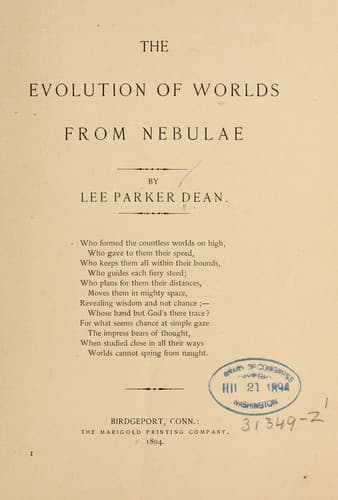
The evolution of worlds from nebulaeDean, Lee Parker
Science
The evolution of worlds from nebulae
Dean, Lee Parker
Nebular hypothesis
the sun the same number enters, this process must forever keep the sun
supplied. Is it not true of the waters of the Niagara Falls that no
more flows down its stream than has already ascended to the clouds in
vapor, then may it not be equally true of the sun’s light and heat?
The gravitation that applies to bodies may also apply to light, and
give to it as much greater an orbit than that of comets as comets
have greater than that of the planets. Though light may have a vastly
greater ellipse it may in the end return to the sun which projects
it, to be again projected. When we think of the molecules in space
that everywhere seem to possess the same properties, and the vastness
of that space, we are ready to conceive that light may have the same
unending properties.
Again, in reference to the stars burning out, or growing old—as is
believed by some to be the case with our own sun and other suns in
space, because of their varied colors and appearances—the following
thoughts may be suggested. At times our sun seems to have dark spots
upon its surface, while in other places great prominences are observed.
This being the case who believes that everywhere the sun emits the same
light and heat; and if not what must be the effect at our distance from
the sun whether a dark spot, or a great projection of flaming hydrogen
is directly before us? Let us imagine a sphere, with the sun for its
centre, that has a radius reaching out a little way beyond earth, and
a surface that might contain 1200 millions of bodies like our earth.
Supposing earth to occupy, in turn, each of these 1200 millions of
places we cannot believe the sun to have the same appearance from each
of them. We are told by Prof. Ball that masses of vapor are frequently
expelled from the interior of the sun with a speed of from 300 to
nearly 1,000 miles a second, although the fact would hardly be credible
only that the spectroscope enables the observer to actually witness the
ascent of these solar prominences at a distance of more than ninety
millions of miles. Now from these facts would one suppose that the sun
could appear the same when viewed from each of those 1,200 millions of
places?
Public-domain text, read in full here on John Shaqi.
Reviews
Reviews
No reviews yet
Be the first to share your thoughts on this work.
Join the Discussion
Join the discussion
Sign in to leave a comment or review.
Sign InorCreate an account