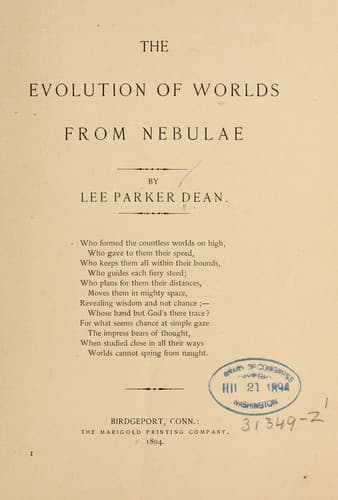
The evolution of worlds from nebulaeDean, Lee Parker
Science
The evolution of worlds from nebulae
Dean, Lee Parker
Nebular hypothesis
When observed from a position directly facing the dark spots the sun
would seem very different from the same body viewed from a place
facing the solar heights whose streams of fire were moving toward one
at the rate of from 500 to 1,000 miles per second. Or let us form a
sphere with the next nearest sun, Alpha Centauri, as its centre, and
a radius of ten trillions of miles. In such a sphere we might place
1,210 quadrillions of earths. Who believes, that were that number of
bodies of earth’s size placed about the star Alpha Centauri, to each
of them it would appear alike, especially if it were like our sun with
dark spots and prominences upon its surface? It would seem that the
light received from it might be so variable that different ages would
be attributed to the sun, according to the position from which it was
observed. Our own sun when seen from different points of the earth’s
surface—as, for instance, from the arctic region or torrid zone—does
not look to us exactly the same. A very little change in the atmosphere
affects the appearance of the sun as we daily view it, and the pictures
of the corona taken at different places—or even at the same place with
different instruments—are found on careful examination to present quite
different appearances.
Once again, assume the sun’s diameter to be one million of miles
with a surface of three trillions of square miles which if two miles
in depth would have twice that number of cubic miles, _i. e._, six
trillions of cubic miles. Imagine then a sphere with a radius of three
billions of miles from the sun’s centre, that is one reaching beyond
the planet Neptune, and we have a sphere containing 108 octillions of
cubic miles in volume, which divided by six trillions gives us 18,000
trillions of centuries, providing the mass has contracted six trillions
of cubic miles each century. It might be said that when the sun had
6,000 millions of miles for its diameter it would have contracted more
than six trillions of miles a century; but we must remember that it
is a law of spherical, gaseous volumes that they revolve swifter and
swifter, and grow hotter and hotter as they contract. Hence, the sun
to-day being smaller is revolving more rapidly and contracting faster
than ever before; though it is not detected by us. As its diameter
and volume must have been larger when it contracted more slowly its
decrease could not have been more rapid, if as rapid as now, and at
the rate of no more than six trillions of miles each century. If this
be true we cannot have over estimated the number of centuries that the
sun has been contracting. Then from these suppositions if the sun’s
energy has not waned in all these 18,000 trillions of centuries, it
seems probable that the Power that has caused it to glow thus long
may continue to give to it an energy that shall flow on with unabated
strength throughout the coming ages.
Public-domain text, read in full here on John Shaqi.
Reviews
Reviews
No reviews yet
Be the first to share your thoughts on this work.
Join the Discussion
Join the discussion
Sign in to leave a comment or review.
Sign InorCreate an account