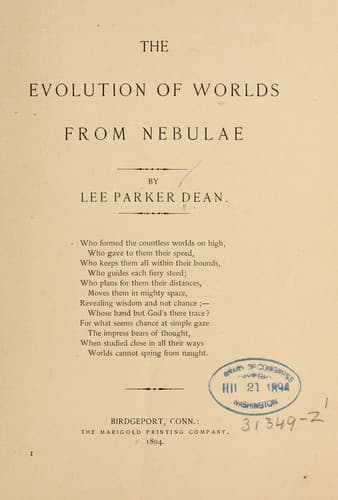
The evolution of worlds from nebulaeDean, Lee Parker
Science
The evolution of worlds from nebulae
Dean, Lee Parker
Nebular hypothesis
We are told by Prof. Ball that such is the translucency of nebulae
one might think to be able to see through them the stars lying in
the back-ground, were they in the right position for observation. If
nebulae are thus translucent it does not seem possible that they can
be composed of the same materials as the planets of the solar system,
whose densities are generally so great. For were the whole of earth’s
substance spread out to one-hundredth of an inch in thickness we can
not believe it would be sufficiently clear to allow light to penetrate
it to any great extent, as earth has a density that leads one to think
it is centrally composed almost—if not wholly—of iron, lead, gold,
or like weighty elements that seemingly would never be transparent
however highly heated and expanded. But if the nebulae are similar to
the planets in their substances they must then consist of enormous
masses of luminous, heated matter in a highly diffused state, in order
to be perceptible to us at so great a distance; and how can they be
translucent if the coloring matter is retained to darken the gases
that are in combustion? Material similar to that of earth, if highly
diffused and placed in an element 300° below zero, would cool almost
immediately; and whether luminous or not would be likely to obstruct
our view of all stars lying behind it.
We are told again by the same writer that doubtless there are hundreds,
thousands, or even millions of dark bodies to each luminous one in
space. But it has not been shown that these dark bodies ever needed to
have been luminous in their formation, neither is it improbable that
non-luminous matter,—even if once highly diffused, and spread out in
the heavens as our sun is supposed once to have been diffused,—should
have formed into these dark, spherical bodies in some manner similar to
the condensation of vapor into clouds. If this be true the presumption
is that the dark bodies are hiding many bright stars from our sight.
It is not possible, then, to conceive that the many stars thus
hidden—or partially hidden—may, like our sun when totally eclipsed,
give a corona-like glow? Our own sun’s corona flames out in every
direction for more than 200 thousand miles, and should there be many
suns eclipsed by the dark bodies in space might they not likewise, in
some instances, present a nebulous appearance with a startling coronal
effect? Theta Orionis, the wondrous multiple star, seemingly lying
in Orion’s great nebula, is regarded as belonging to it because of
its being in the same degree of the heavens; but although in the same
degree it may be in quite a different plane, as light travels at the
rate of over eleven millions of miles per minute. If this nebula is
unresolvable stars then the light from it may be millions of years in
reaching us, while from Theta Orionis, if it lies in the foreground,
the light might reach us possibly in one hundred years,—according
to the distance it is removed from earth. The probabilities are
Public-domain text, read in full here on John Shaqi.
Reviews
Reviews
No reviews yet
Be the first to share your thoughts on this work.
Join the Discussion
Join the discussion
Sign in to leave a comment or review.
Sign InorCreate an account