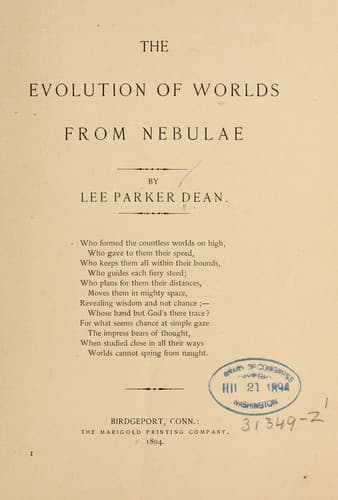
The evolution of worlds from nebulaeDean, Lee Parker
Science
The evolution of worlds from nebulae
Dean, Lee Parker
Nebular hypothesis
that the multiple star lies nearest the earth, for if the nebula is
composed of material similar to earth, we could not think at such a
distance to be able to see through a single foot, or even inch, of its
substance. There are about 5,000 stars visible to the naked eye in
both the northern and southern hemispheres, but only about one-third
of that number are visible at any one time. Few people are able to
see two thousand of them on the clearest night, while many do not see
one thousand, because of their inability to detect those of the sixth
magnitude. The Milky-Way, therefore, is quite like a great nebula to
man’s unaided vision. At each increase of photographic and telescopic
power new stars are observed, until it is now said that 100 millions
may be visible by their aid. If all these knowable stars are no more
to space than a drop of water is to the Atlantic ocean, as the above
writer has said, it is not in the least surprising that we see a
great number of nebulae. This we must ever expect, even though our
telescopes be increased a millionfold in power. In fact it would be
most surprising if unresolvable nebulae did not forever appear in space
as often as instruments of increasing penetration should be brought
into positions to examine them. If space, like our oceans and our
atmosphere, should be subordinate to something greater that we have
never seen, and have no prospect of seeing in our present state, we can
form concerning it no adequate conception.
To obtain an impression of the greatness of the nebulae in the heavens
let us discord every instrument as though there were none, and upon
some clear, moonless night stand gazing into the starry heavens. It
might seem as though we were looking at millions of stars, but we
should find by counting that the distinct points of light were only
about one thousand. Imagine our sight to increase so that we beheld two
thousand stars, then four thousand, eight thousand, and so on until
finally, with our sight increased a thousand-fold, we were able to see
one hundred millions of stars, the number that may be seen with the
most powerful instruments. What we beheld as nebulae when we saw but
one thousand distinct stars would thus be resolved into shining suns
with sufficient increase of power. Then is it not a fair supposition
that—if our sight were adapted to the beholding—we should be able to
detect not only one hundred millions of stars, but myriads of them?
Again, when we think of the irregular shapes that many of the nebulae
have, can we believe that they are rotating like the sun and planets?
for we look to spherical bodies for revolution. We know there are
many peculiar-shaped nebulae emitting light and heat, yet that light
and heat may in nowise be produced by their swift revolutions, and we
cannot think of them as undergoing a change such as we would expect
from the nebular theory of world-formation.
Public-domain text, read in full here on John Shaqi.
Reviews
Reviews
No reviews yet
Be the first to share your thoughts on this work.
Join the Discussion
Join the discussion
Sign in to leave a comment or review.
Sign InorCreate an account