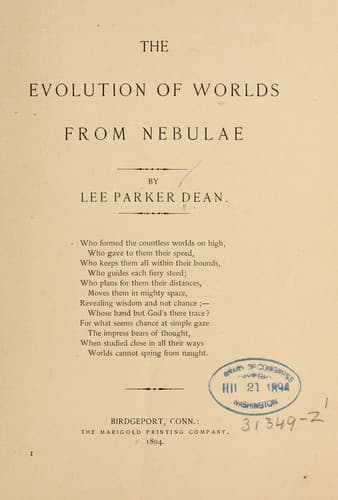
The evolution of worlds from nebulaeDean, Lee Parker
Science
The evolution of worlds from nebulae
Dean, Lee Parker
Nebular hypothesis
In reference to the nebula in the Sword’s-handle of Orion, which
contains matter sufficient to form two thousand and two hundred
trillions of suns like our own; if this matter is of any density—or if
not, even—it would seemingly cool almost instantly in an element 300°
below zero. In truth how could it have become heated unless composed
of some combustible element, like hydrogen, that would spring of
itself into a mass of flame with an energy,—if there is conservation
of energy,—that would exist for ever, and might repeat its work over
and over again as do the oceans of our earth? There is no evidence,
as far as we have ascertained, that this nebula rotates; nor can we
believe that its luminosity is caused by swift revolution when our own
sun, less than one million of miles in diameter, rotates but once in
twenty-five days and is now moving swifter, according to the laws of
mechanics appertaining to spherical, vaporous bodies, than ever before.
Even scientists and philosophers cannot tell us of the formation of a
grass-seed, from which springs life identical with its kind; neither
can they detect with the best microscope any difference between the
varied forms of matter in the first stages of inception, nor feel sure
whether there will be developed therefrom a tree, a dog, an elephant,
or a man. For two hundred years _spontaneous combustion_ has been
discussed, some finding from an infusion of hay that life appeared;
but when the idea was supposed to have been proved it was discovered
that life was in _air_, and with the life-germs taken from it no
spontaneous generation would arise. Later it was found that bacteriae
would exist in great heat, and from that fact _biogenesis_ was thought
proved; for life only could come from life. We remember also that for
years the famous Bodes Law was considered fully established, until
upon the discovery of planet Neptune it was found to be so far out of
position that the law was no longer applicable to the distribution of
the planets of the solar system. Remembering all these changes after
science considered the theories well established, we believe there are
things to-day about nebulae, even, that conflict with the hypothesis
under consideration; as, for instance the irregular shape they often
assume, and the fact that many have already been resolved into stars
with the aid of sufficiently powerful instruments.
[Illustration: Decoration]
CHAPTER IX.
LIMITATIONS.
Public-domain text, read in full here on John Shaqi.
Reviews
Reviews
No reviews yet
Be the first to share your thoughts on this work.
Join the Discussion
Join the discussion
Sign in to leave a comment or review.
Sign InorCreate an account