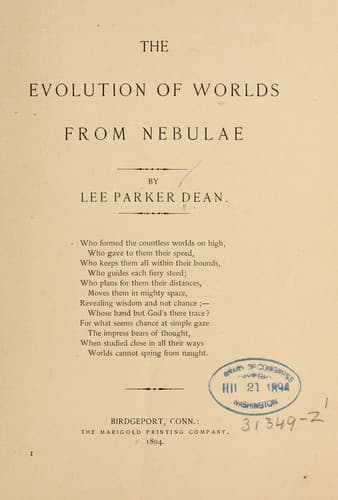
The evolution of worlds from nebulaeDean, Lee Parker
Science
The evolution of worlds from nebulae
Dean, Lee Parker
Nebular hypothesis
[2] “Laplace has given us proof that the period of the earth’s axial
rotation has not changed 1-100 of a second of time in two thousand
years.”
Warren. “Recreations in Astronomy,” p. 145.
[3] Ball. “In Starry Realms,” p. 31.
CHAPTER II.
DENSITY AND GRAVITATION.
1st. _Density._ The sun’s density is one-fourth that of earth, while
Mercury’s is one-fifth greater than earth’s, showing that Mercury’s
substance must be more than five times denser than the sun’s, whereas
it is not 36,000,000 miles distant from it; so near, in fact, and so
recently thrown off from the sun as to be thought that human beings
could not live upon it. Why is it that this dense substance did not,
while a portion of the sun, sink to its centre?
It might be said that on cooling, after being thrown from the sun, the
body became more and more dense, the same as is said of earth. But if
so why is it that Neptune, seventy-five times farther from the sun, has
a density only one-fifth that of earth, and Uranus but a little more;
while Jupiter’s density is less than the sun’s, and Saturn’s not even
one-seventh that of earth? All of these planets lie in an immensely
cold and far away region and were thrown off by the sun, if at all,
many years before Mercury, and, according to the supposed theory,
should be cold bodies.
Some think, with apparent show of reason, that before planet-making
began the heavier materials of the general mass had gravitated toward
the centre, while the lighter substances remained near the surface.
“If so,” to quote the words of Prof. Winchell, “the first planets
separated would contain more of the substances which, at temperatures
familiar to us, make gases and water. Similarly, the later planets
disengaged would acquire a large proportion of the substances which
form solid rocks. In the case of the earth we may suppose that the
greater part was rock-making material, since the earth’s specific
gravity is so high; but watery stuff in sufficient amount to provide
for oceans and rains, went off with the rock-material, and with these,
the lighter stuff for an atmosphere. But in the case of Venus, most
of the stuff was rock-material, if not the whole of it; while with
Mercury it seems probable that little water-stuff was included. In the
opposite direction, Saturn, Uranus, and Neptune must have received a
large excess of water and atmospheric stuff. It is rational to suppose
that their oceans have always covered the whole land, as ours does more
than half. In fact, these bodies must be composed chiefly of water and
atmosphere; as their specific gravities are low as water and cork.”[4]
Now if this is a good explanation what shall we say of the sun from
which these planets were separated? If it grew more and more solid as
it contracted until Mercury, nearly ten times denser than Saturn, was
thrown off, why is not the sun denser than Mercury? whereas we find it
with but one-fourth the density of earth.
Public-domain text, read in full here on John Shaqi.
Reviews
Reviews
No reviews yet
Be the first to share your thoughts on this work.
Join the Discussion
Join the discussion
Sign in to leave a comment or review.
Sign InorCreate an account