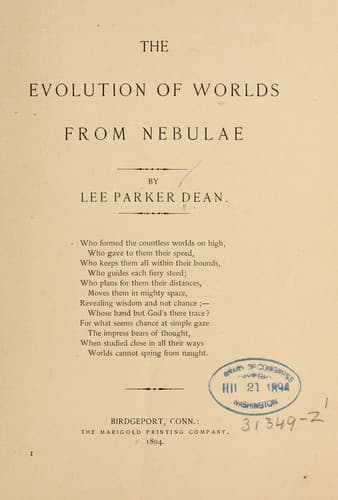
The evolution of worlds from nebulaeDean, Lee Parker
Science
The evolution of worlds from nebulae
Dean, Lee Parker
Nebular hypothesis
Professor Ball tells us that in gaseous bodies the loss of heat
involves a corresponding contraction of the volume, attended with a
rise of temperature. To quote his words: “As the temperature of the
mass increases the rate at which it parts with heat also increases.
The contraction of the volume will proceed at an accelerated pace, and
the temperature rise with increasing rapidity. Though the temperature
of the gas may at first have been extremely low it will gradually
rise until it becomes sufficiently high to render the gas visible by
actual incandescence. As the process advances still further the body
may pass from a mere nebula into a star-like object. With increase
of contraction the pressure also increases and materials which were
originally gaseous will assume more and more a density resembling
that of solid bodies.” He says further that should the sun contract
into a globe less its present size by one ten-thousandth part of
its diameter it would amount to a shrinkage in its diameter of 87
miles. “But,” he continues, “on so mighty a globe this alteration is
relatively insignificant; indeed no measurements that could be made at
our observatories would be sufficiently delicate to detect a change of
this magnitude. Helmholtz has, however, shown that if the sun were to
undergo even this small diminution of volume the quantity of heat that
would be thereby liberated for the purposes of radiation would supply
the sun’s current rate of expenditure for nearly 2000 years. We have no
means of knowing at present whether the actual contraction of the sun
takes place at this rate or any other rate.”[3]
Thus we see astronomers admit that a contraction of merely four miles
of the sun’s diameter would be sufficient to supply its heat for a
century, while a contraction of 87 miles, or 1/10,000 part of its
diameter, would give to it heat for twenty centuries, were the sun
gaseous. This being the case how is it possible to detect in this
century, with a contraction of but four miles, whether the sun is
growing either larger or smaller, or in any wise changing its volume?
When its diameter was twice as large as now it must have been so
much cooler that it moved more slowly and radiated less heat. With
a diameter of 10 millions of miles, of 100, 1,000, 3,000, or 6,000
millions of miles even, and the sun then more years than it is now days
in turning, can we suppose that it revolved swiftly enough to throw off
rings; or, with a surface so expanded, was possessed of heat to any
great amount? These are thoughts that should be carefully considered in
looking at the theory of the formation of worlds from nebulae; for any
explanations concerning the existence of a fire-mist so extensive as
to reach Neptune’s bounds are of no small consideration, and should be
open to careful scrutiny before absolute acceptance.
[Illustration: Decoration]
FOOTNOTES:
[1] Warren. “Recreations in Astronomy,” p. 182.
Public-domain text, read in full here on John Shaqi.
Reviews
Reviews
No reviews yet
Be the first to share your thoughts on this work.
Join the Discussion
Join the discussion
Sign in to leave a comment or review.
Sign InorCreate an account