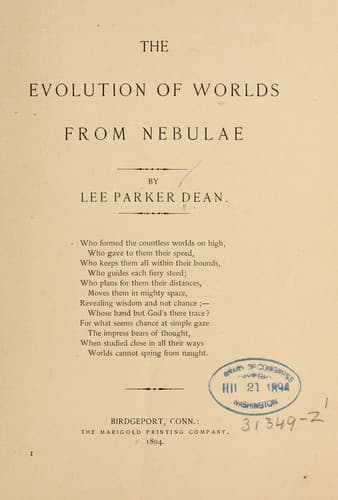
The evolution of worlds from nebulaeDean, Lee Parker
Science
The evolution of worlds from nebulae
Dean, Lee Parker
Nebular hypothesis
Or, take another theory, and instead of supposing that the sun threw
off rings, suppose that its surface cooled and formed into a hard
crust. Had the inner sun then shrunk away from the outer could that
crust have ever formed into a globe that would rotate around the inner
sphere, and if not how could Neptune have been formed? Should such
a crust have extended around the sun while spread out to Neptune it
must have had a circumference of over 18,000 million miles, as did the
ring, with a surface of 108 quintillions of square miles; so the crust
could not have exceeded one-sixtieth of an inch in thickness. If, then,
Neptune’s substance in any way resembles earth’s, with a crust of that
thickness upon the sun’s surface, it must have collapsed in millions of
places instead of having broken away from the sun and formed the globe
that we now behold. Chambers tells us: “At the surface of the earth a
body set free in space falls 16.1 ft. in the first second of time, with
a velocity increasing during each succeeding second. A body similarly
set free at the surface of the Sun would start with a velocity 27.4
times as great as that of a body falling at the surface of the Earth.
This is equivalent to saying that a pound’s weight of anything on
the Earth would, if removed to the Sun, weigh more than 27 lbs. The
centrifugal force, due to the rotation of any body diminishes gravity
at its surface. At the Earth’s equator the total diminution is 1/289
part; whilst at the Sun’s equator the centrifugal force is only about
1/18,000 part the force of gravity. It would be necessary that the Sun
should turn on its axis 133 times quicker than it does, for the force
of gravity to be neutralized. In the case of the Earth, however, a
speed of rotation 17 times as great as it is would suffice to produce
the same result.”[6]
By this it is seen the centrifugal force is comparatively insignificant
with the sun revolving faster than ever before; for, on the principle
that the more a body contracts, the swifter it revolves, it must
revolve several hundred times faster now than it did when its
circumference was at Neptune’s bounds. If this be the case it is
difficult to believe there was ever a time that the sun could have been
larger than at the present, and have had centrifugal force enough to
throw off rings from its surface.
[Illustration: Decoration]
FOOTNOTES:
[4] Winchell, “Walks and Talks in the Geological Field,” p. 217.
[5] Steele’s “New Descriptive Astronomy,” p. 174.
[6] Chambers’ “Hand Book of Astronomy,” p. 6.
CHAPTER III.
THE COOLING OF THE PLANETS.
Public-domain text, read in full here on John Shaqi.
Reviews
Reviews
No reviews yet
Be the first to share your thoughts on this work.
Join the Discussion
Join the discussion
Sign in to leave a comment or review.
Sign InorCreate an account