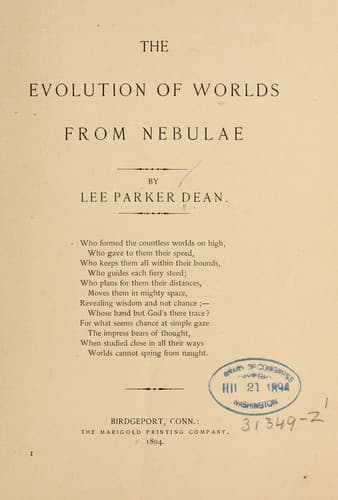
The evolution of worlds from nebulaeDean, Lee Parker
Science
The evolution of worlds from nebulae
Dean, Lee Parker
Nebular hypothesis
1st. If the sun was once so much greater that it reached out to
Neptune,—as it must have done if Neptune was cast off from it,—would
not its poles have flattened like those of Earth, and have cooled
first, and any matter thrown off from the globe have been at the poles?
Yet the poles of Earth seem scarcely to change as it turns on its axis,
and a body thrown off from them would not go around the planet; but,
on cooling, fall back to the liquid centre. Such being the case why
has earth a density greater than the sun, and what was the power that
kept, and still keeps it, from sinking into the sun? Knowing as we do
the power of gravitation, we should suppose these masses to be so held
that they could not escape from the sun. Saturn, with its three glowing
rings, we behold as a blazing star,[7] but why has it not cooled? The
sun must have thrown off the planet millions of years ago, for it now
lies about 900 millions of miles distant, and the contracting of the
sun on its radius would make it 450 millions of centuries since it
spread out as far as Saturn. Hence, if Earth is cold Saturn should be
the same in that far-away, colder region; and being ten times farther
from the sun than the earth, it should have been formed ten times as
long ago, according to the nebular hypothesis.
If Saturn yet throws off rings may not the sun do the same until cool
as Saturn and reduced to a like size? At the time the sun spread out
to that planet its diameter must have been 1800 millions of miles,
whereas now it is about 900,000 miles. With such a diameter shrunken
to less than one million of miles we would ask why Saturn is not yet
cool? Should we extend the sun’s diameter again to reach Saturn, it
would have, as stated, a radius of 900 millions of miles; giving 10,000
million times its present volume. By contracting the same at a like
rate it would be 450 millions of centuries ago that Saturn was thrown
off from the sun. Now, as Saturn has only 1/1700 part of the sun’s
volume, with a density much less, and lies far out in space; why in
all these millions of years has it not cooled instead of holding heat
and continuing to throw off rings? If it possesses the exceedingly
light density sometimes claimed for it,[8] and has a gravitation at its
surface but little more than that of Earth, one would suppose to find
it a much colder object than the earth.
Public-domain text, read in full here on John Shaqi.
Reviews
Reviews
No reviews yet
Be the first to share your thoughts on this work.
Join the Discussion
Join the discussion
Sign in to leave a comment or review.
Sign InorCreate an account