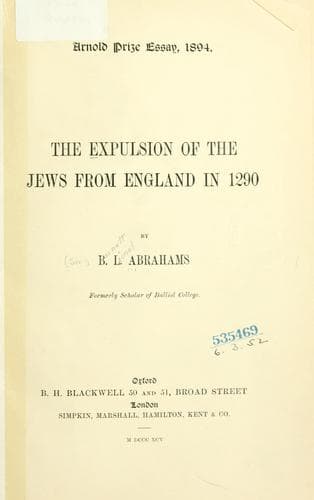
The expulsion of the Jews from England in 1290 — John Shaqi
The expulsion of the Jews from England in 1290Abrahams, Barnett Lionel
History
The expulsion of the Jews from England in 1290
Abrahams, Barnett Lionel
Jews -- Great Britain -- History
Powerless as the Jews were against royal oppression in England, the
position that was offered to them by Richard and John was no worse
than that of their co-religionists in other countries of Europe. Those
of Germany were the Emperor’s _Kammerknechte_;[33] those of France
had been expelled in 1182, and though they were soon recalled, might
at any time be expelled again.[34] A Jew in a feudalised country was
liable to be the subject of quarrel between the lord on whose estate
he dwelt and the king of the country, and he could be handed about,
now to the one and now to the other.[35] The right to live and to be
under jurisdiction, was everywhere still a local privilege that had to
be enjoyed by the permission of a lord, lay or clerical, and had to
be paid for. In England, the Jews, so long as they were protected by
the King, were at any rate under the greatest lord in the land. The
towns where especially they wished to settle for the purposes of their
business, were, thanks to the policy of William the Conqueror, mostly
on the royal domain. And the royal power acting through its local
officers was used to the full to protect the Jews. The sheriffs of the
counties were especially charged to secure to them personal safety and
the enjoyment of the immunities that had been granted to them.[36]
The arrangement by which Jewish money-lenders received on English
soil the protection of the King against his own subjects was not very
honourable to either of the parties. But the King had no compunction,
and the Jews had no choice. It could endure so long as the royal power
was strong enough to override the objections of barons and abbots to a
measure in favour of their creditors, of the towns to an encroachment
on their privileges, and of the Church to the royal support of a body
of infidel usurers.
At the end of the twelfth century neither towns nor landholders nor
Church were in a position to offer any effectual protest. In the
thirteenth century the strength of the opposition of each of these
three orders grew steadily. But in each it pursued a separate course,
though to the same end, and each order struck its decisive blow at
a different moment. Hence the various forms of opposition must be
separately considered.
III.--THE CONFLICT WITH THE TOWNS.
Public-domain text, read in full here on John Shaqi.
Reviews
Reviews
No reviews yet
Be the first to share your thoughts on this work.
Join the Discussion
Join the discussion
Sign in to leave a comment or review.
Sign InorCreate an account