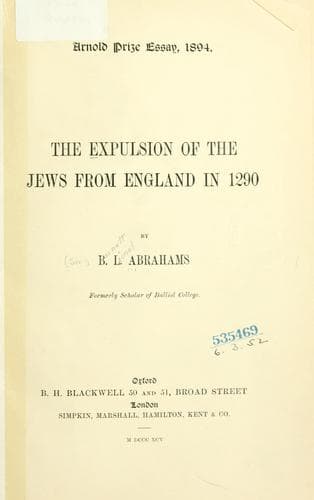
The expulsion of the Jews from England in 1290Abrahams, Barnett Lionel
History
The expulsion of the Jews from England in 1290
Abrahams, Barnett Lionel
Jews -- Great Britain -- History
The towns were the first to carry out a practical and effective
anti-Jewish policy. It was they that suffered most keenly and
constantly from the presence of the Jews. They had bought, at great
expense, from King or noble or abbot, the right to be independent,
self-governing communities, living under the jurisdiction of their own
officers, free from the visits of the royal sheriffs, and paying a
fixed sum in commutation of all dues to the King or the local lord;
and yet many of them saw the King protecting in their midst a band
of foreigners, who had the royal permission to go whithersoever they
pleased, who could dwell among the burgesses, and were yet free not
only from all customs and dues and contribution to the ferm,[37] but
even from the jurisdiction of those authorities which were responsible
for peace and good government.[38] This was exasperating enough; but
there was more and worse. The exclusion of the sheriff and the King’s
constables was one of the most cherished privileges of towns, but,
wherever the Jews had once taken up their residence, it was in danger
of being a mere pretence. At Colchester, if a Jew was unable to recover
his debts, he could call in the King’s sheriffs to help him. In London,
Jews were “warrantised” from the exchequer, and the constable of the
Tower had a special jurisdiction by which he kept the pleas between
Jews and Christians. At Nottingham, complaints against Jews, even in
cases of petty assaults, were heard before the keeper of the Castle.
At Oxford the constable called in question the Chancellor’s authority
over the Jews; contending that they did not form part of the ordinary
town-community.[39] Moreover, the debts of the Jews were continually
falling into the King’s hands, and whenever this happened, his officers
would no doubt penetrate into the town to make on behalf of the royal
treasury a collection such as had never been contemplated when the
burgesses made their agreement, which was to settle once and for all
their payment to the King.[40]
In some of the towns the feeling against the Jews was expressed in
riots as early as the reign of John, and the beginning of that of Henry
III. But the King in each case took stern measures of repression. John
told the mayor and barons of London that he should require the blood
of the Jews at their hands if any ill befell them.[41] In Gloucester
and in Hereford, the burgesses of the town were made responsible for
the safety of the Jews dwelling amongst them. In Worcester, York,
Lincoln, Stamford, Bristol, Northampton, and Winchester, the sheriffs
were charged with the duty of protecting them against injury.[42] Such
measures only increased the ill-feeling of the burgesses. At Norwich in
1234 the Jewry was fired and looted.[43] The Jews were maltreated and
beaten, and were only saved from further harm by the timely help of the
garrison of the neighbouring castle. At Oxford the scholars attacked
the Jewry and carried off “innumerable goods.”[44]
Public-domain text, read in full here on John Shaqi.
Reviews
Reviews
No reviews yet
Be the first to share your thoughts on this work.
Join the Discussion
Join the discussion
Sign in to leave a comment or review.
Sign InorCreate an account