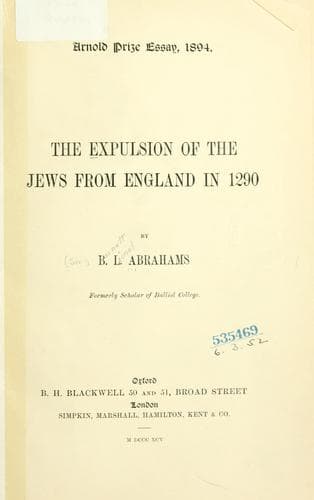
The expulsion of the Jews from England in 1290Abrahams, Barnett Lionel
History
The expulsion of the Jews from England in 1290
Abrahams, Barnett Lionel
Jews -- Great Britain -- History
At the same time that the towns were making their attack on the Jews
in their own way, there was growing up within the baronial order a
new party, stronger than the towns in the elements of which it was
composed and in its capacity for joint action, and filled, on account
of the private circumstances of its members, with a deeper hatred of
the Jews than the greater barons, who had hitherto represented the
order, had ever known. For the old Baronial party which had forced
Magna Carta on John was too rich to be seriously indebted to the Jews,
and the anti-Jewish feeling of its members must have been blunted by
the fact that, when they had to pay their debts, they could raise the
money by benevolences levied on their tenants.[49] Moreover some of
them imitated on their own estates the King’s policy of sharing in the
profits of usury.[50] Hence they were little influenced by personal
grievances, and it was no doubt partly from political considerations,
and partly as a concession to the lesser and poorer members of their
order, that they had introduced into Magna Carta certain limitations
of the power of the Jews, or of their legatee, the King, over the
estates of debtors, a measure which, small as it was, was repealed
on the re-issues of the charters, when, during the minority of Henry
III., the great Barons had to undertake the duty of Government. And yet
even the great Barons must have felt, after twenty years’ experience
of the personal Government of Henry III., that an alteration in the
Royal system of managing the Jewry was necessary if their order was
ever to succeed in the constitutional struggle in which it was engaged.
They knew that many of those among the King’s acts which they hated
worst would have been impossible but for the Jews. It was by money
extorted from them that he had been enabled to prolong his expeditions
in Brittany and Gascony, to support and enrich his foreign favourites,
and to baffle the attempts of the Council to secure, by the refusal of
supplies, the restoration of Government through the customary officers.
In 1230, and again in 1239, he took from them a third of their
property; in 1244, he levied a tallage of 60,000 marks; in 1250, 1252,
1254, and 1255 he ordered the royal officers to take from them all that
they could exact, after thorough inquisition and the employment of
measures of compulsion so cruel as to make the whole body of Jews in
England ask twice, though each time in vain, for permission to leave
the country. Thus the whole Baronial order was for a time united, on
the ground of constitutional grievances, in a policy which found its
expression in the successful attempt of the National Council in 1244
to exact from the King the right of appointing one of the two justices
of the Jews, so as to gain a knowledge of the amount of the Jewish
revenue, and a power of controlling its expenditure.[51]
Public-domain text, read in full here on John Shaqi.
Reviews
Reviews
No reviews yet
Be the first to share your thoughts on this work.
Join the Discussion
Join the discussion
Sign in to leave a comment or review.
Sign InorCreate an account