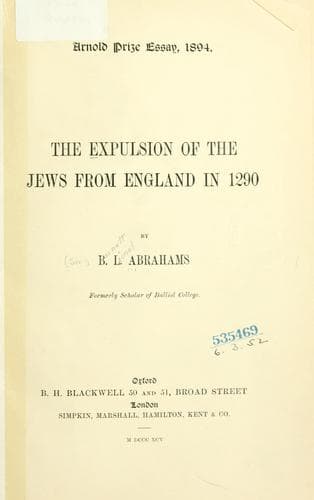
The expulsion of the Jews from England in 1290Abrahams, Barnett Lionel
History
The expulsion of the Jews from England in 1290
Abrahams, Barnett Lionel
Jews -- Great Britain -- History
But such a measure did nothing to relieve the personal grievances
of the lower baronage, and it was naturally from this class that
further complaints proceeded. Its members, unlike the greater barons,
made no profit from the encouragement of usury. On the other hand,
they were among the greatest sufferers from the practice. Many a one
among them must, when summoned to take part in the King’s foreign
expeditions, have been compelled to pledge some land to the Jews in
order to be able to meet the expenses of service; and no doubt the
Jews derived from such transactions a large share of the profits that
enabled them to make their enormous contributions to the exchequer.
A landholder’s debt to a Jew would, when once contracted, have been,
under any circumstances, difficult to pay off. But the lower baronage,
or knight’s bachelors, were threatened, when they had fallen into debt,
with new dangers, the knowledge of which intensified their hatred of
the whole system of money-lending. “We ask,” they said in the petition
of 1259, “a remedy for this evil, to wit, that the Jews sometimes give
their bonds, and the land pledged to them, to the magnates and the
more powerful men of the realm, who thereupon enter on the land of the
lesser men, and although those who owe the debt be willing to pay it
with usury, yet the said magnates put off the business, so that the
land and tenements may in some way remain their property, ... and on
the occasion of death, or any other chance, there is a manifest danger
that those to whom the said tenements belonged may lose all right in
them.”[52]
The special wrongs of the lower baronage were, in the course of the
Civil War, temporarily lost sight of. Nevertheless, the action of the
whole baronial party throughout the war contributed greatly, though
indirectly, to the ultimate banishment of the Jews from England.
Just as the towns had, by their measures of exclusion, weakened
the mercenary bond that united the Jews to the King, so now the
barons, by their wholesale destruction of Jewish property, worked, as
unconsciously as the towns had done, to the same end. They attacked
and plundered the Jewry of London twice in the course of the war, and
destroyed those of Canterbury, Northampton, Winchester, Cambridge,
Worcester, and Lincoln. Everywhere they carried off or destroyed the
property of their victims. In London they killed every Jew that they
met, except those who accepted baptism, or paid large sums of money.
They took from Cambridge all the Jewish bonds that were kept there, and
deposited them at their head-quarters in Ely. At Lincoln they broke
open the official chests, and “trod underfoot in the lanes, charters
and deeds, and whatever else was injurious to the Christians.”[53] “It
is impossible,” says a chronicler, in describing one of these attacks,
“to estimate the loss it caused to the King’s exchequer.”
V.--THE BEGINNING OF EDWARD’S POLICY OF RESTRICTION.
Public-domain text, read in full here on John Shaqi.
Reviews
Reviews
No reviews yet
Be the first to share your thoughts on this work.
Join the Discussion
Join the discussion
Sign in to leave a comment or review.
Sign InorCreate an account