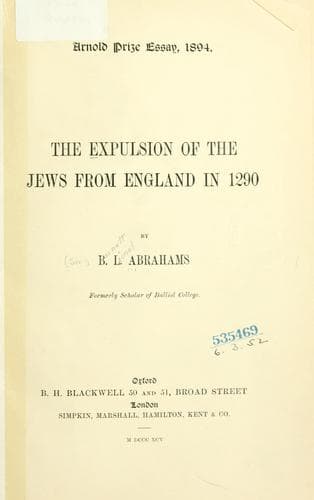
The expulsion of the Jews from England in 1290 — John Shaqi
The expulsion of the Jews from England in 1290Abrahams, Barnett Lionel
History
The expulsion of the Jews from England in 1290
Abrahams, Barnett Lionel
Jews -- Great Britain -- History
Very soon after the passing of the Statute of 1270, Edward left England
to join the second Crusade of St. Louis, and did not return till
1274, two years after he had been proclaimed king. At once he took up
with characteristic vigour, and with the help and advice of a band of
statesmen and lawyers, the work of administrative reform that he had
already begun as heir-apparent. He recognised that the state of affairs
established in 1270 could not endure, since, under it, the Jews, while
practically prevented from lending money at interest, now that the
law forbade them to take in pledge real property, the only possible
security for large loans, were nevertheless still nothing but usurers,
allowed by ancient custom and royal recognition to carry on that one
pursuit as best they could, and prevented by the same forces from
carrying on any other. Edward, with his usual love for “the definition
of duties and the spheres of duty,”[79] felt that it was necessary to
define for the Jews a new position, which should not, as did their
present position, condemn them to hopeless struggles, nor demand from
him acquiescence in what he believed to be a sin.
For the Church had never ceased to maintain the doctrine of the
sinfulness of usury which Ambrose and Clement, Jerome and Tertullian,
had taught in strict conformity with the communistic ideas of primitive
Christianity. It is true that till the eleventh century usury and
speculative trading generally had not been active enough to call for
repression, nor would the Church have been strong enough to enforce on
the Christian world the observance of its doctrine. It could not follow
up the attempt made by the Capitularies of Charles the Great to prevent
laymen from practising usury, and it had to rest content with enforcing
the prohibition on clerics.[80] But the growth under Hildebrand of
the power of the Church over every-day life, and the elevation of the
moral tone of its teaching that resulted from its struggles with the
temporal power, enabled it to adopt with increasing effect measures
of greater severity. Hildebrand, in 1083, decreed that usurers
should, like perjurers, thieves, and wife-deserters, be punished with
excommunication;[81] and the Lateran General Council of 1139, when
exhorted by Innocent II. to shrink from no legislation as demanding
too high and rigorous a morality, decreed that usurers were to be
excluded from the consolations of the Church, to be infamous all their
lives long, and to be deprived of Christian burial.[82] The religious
feeling aroused by the Crusades still further strengthened the hold on
the Christian world of characteristically Christian theory, while the
prospect of the economic results that they threatened to bring about in
Europe, awoke the Church to the advisability of putting forth all its
power to protect the estates of Crusaders against the money-lenders.
Many Popes of the twelfth century ordained, and St. Bernard approved
Public-domain text, read in full here on John Shaqi.
Reviews
Reviews
No reviews yet
Be the first to share your thoughts on this work.
Join the Discussion
Join the discussion
Sign in to leave a comment or review.
Sign InorCreate an account