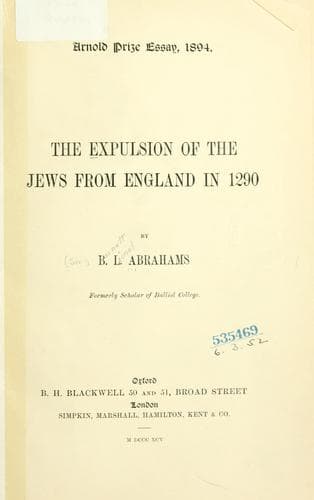
The expulsion of the Jews from England in 1290Abrahams, Barnett Lionel
History
The expulsion of the Jews from England in 1290
Abrahams, Barnett Lionel
Jews -- Great Britain -- History
of the ordinance[83] that those who took up the Cross should be freed
from all engagements to pay usury into which they might have entered.
Innocent III. absolved Crusaders even from obligations of the kind that
they had incurred under oath, and subsequently ordered that Jews should
be forced, under penalty of exclusion from the society of Christians,
to return to their crusading debtors any interest that they had already
received from them.[84]
Stronger even than the influence of the Crusades was that of the
Mendicant Orders. The Dominicans, who preached, and the Franciscans,
who “taught and wrought” among all classes of people throughout
Europe, carried with them, as their most cherished lesson, the
doctrine of poverty. It was by the teaching of this doctrine, and
by the practice of the simple unworldly life of the primitive
Church, that the founders of the two orders had been able to give
new strength to the ecclesiastical institutions of the thirteenth
century. And their teaching, if not their practice, made its way from
the Casiuncula to the Vatican. Cardinal Ugolino, the dear friend of
S. Francis, became Gregory IX.; Petrus de Tarentagio, of the order
of the Dominicans, became Innocent IV.; and Girolamo di Ascoli, the
“sun” of the Franciscans, was soon to become Nicholas IV. Moreover,
the work of formulating and publishing to the world the official
doctrines of the Church was in the hands of the Mendicants. A
Dominican, Raymundus de Peñaforte, was entrusted by Gregory IX. with
the preparation of the Decretals, which formed the chief part of the
canon law of the Church.[85] And friars of both orders codified with
indefatigable labour the moral law of Christianity, and set it forth
in hand-books, or _Summæ_, which were universally accepted as guides
for the confessional, and which all agreed in condemning usury.[86]
Hence, the doctrine of its sinfulness was taught throughout Christian
Europe, by priests and monks, by Dominican preachers and Franciscan
confessors, who could enforce their lesson by the use of their power
of granting or refusing absolution. How strong and violent a public
opinion was thus created is best shown in the lines in which Dante, the
contemporary of Edward I., tells with what companions he thought it fit
that the Caursine usurers should dwell in hell.[87]
Public-domain text, read in full here on John Shaqi.
Reviews
Reviews
No reviews yet
Be the first to share your thoughts on this work.
Join the Discussion
Join the discussion
Sign in to leave a comment or review.
Sign InorCreate an account