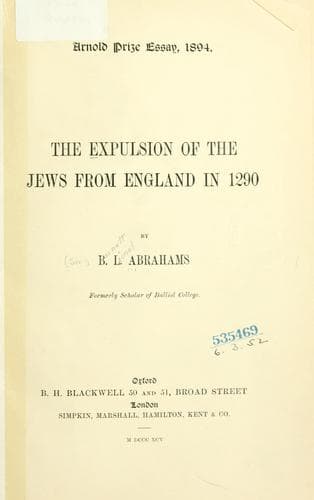
The expulsion of the Jews from England in 1290Abrahams, Barnett Lionel
History
The expulsion of the Jews from England in 1290
Abrahams, Barnett Lionel
Jews -- Great Britain -- History
The expulsion of the Jews from England by Edward I. is a measure
concerning the causes of which no contemporary historian gives, or
pretends to give, any but the most meagre information. It was passed
by the King in his “secret council,” of the proceedings of which
we naturally know nothing. Of the occasion that suggested it, each
separate writer has his own account, and none has a claim to higher
authority than the rest; and yet there is much in the circumstances
connected with it that calls for explanation. How was it that, at a
time when trade and the need for capital were growing, the Jews, who
were reputed to be among the great capitalists of Europe, were expelled
from England? How did Edward, a king who was in debt from the moment
he began his reign till the end, bring himself to give up the revenue
that his father and grandfather had derived from the Jews? How could
he, as an honourable king, drive out subjects who were protected by
a Charter that one of his predecessors had granted, and another had
solemnly confirmed? To answer these questions we must consider what
was the position that the Jews occupied in England, how it was forced
on them, and how it brought them into antagonism at various times with
the interests of the several orders of the English people, and with
the teachings of the Catholic Church. We shall thus find the origin
of forces strong enough when they converged to bring about the result
which is to be accounted for.
I.--THE JEWS FROM THEIR ARRIVAL TO 1190.
Among the foreigners who flocked to England at, or soon after, the
Conquest were many families of French Jews. They brought with them
money, but no skill in any occupation except that of lending it out
at interest. They lent to the King, when the ferm of his counties, or
his feudal dues were late in coming in;[1] to the barons, who, though
lands and estates had been showered on them, nevertheless often found
it hard, without doubt, to procure ready money wherewith to pay for
luxuries, or to meet the expense of military service; and to suitors
who had to follow the King’s Court from one great town to another, or
to plead before the Papal Curia at Rome.[2]
Public-domain text, read in full here on John Shaqi.
Reviews
Reviews
No reviews yet
Be the first to share your thoughts on this work.
Join the Discussion
Join the discussion
Sign in to leave a comment or review.
Sign InorCreate an account