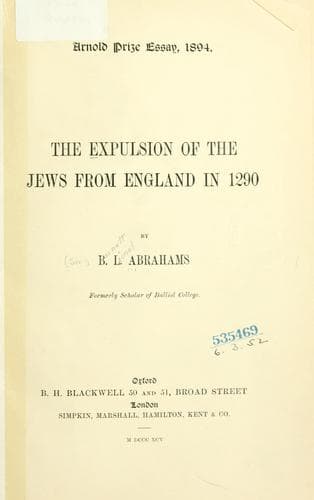
The expulsion of the Jews from England in 1290Abrahams, Barnett Lionel
History
The expulsion of the Jews from England in 1290
Abrahams, Barnett Lionel
Jews -- Great Britain -- History
But though they thus came into contact with many classes, and had
kindly relations with some, they remained far more alien to the masses
of the people around them than even the Normans, in whose train they
had come to England. Even the Norman baron must, a hundred years after
the Conquest, have become something of an Englishman. He held an
estate, of which the tenants were English; he presided over a court
attended by English suitors. In battle he led his English retainers. He
and the Englishman worshipped in the same church, and in it the sons
of the two might serve as priests side by side. But the Jews remained,
during the whole time of their sojourn in England, sharply separated
from, at any rate, the common people around them by peculiarities of
speech, habits and daily life, such as must have aroused dread and
hatred in an ignorant and superstitious age. Their foreign faces alone
would have been enough to mark them out. Moreover, they generally
occupied, not under compulsion, but of their own choice, a separate
quarter of each town in which they dwelt.[3] And in their isolation
they lived a life unlike that of any other class. None of them were
feudal landowners, none farmers, none villeins, none members of the
guilds. They did not join in the national Watch and Ward. They alone
were forbidden to keep the mail and hauberk which the rest of the
nation was bound to have at hand to help in preserving the peace.[4]
They were not enrolled in the Frank-pledge, that society that brought
neighbours together and taught them to be interested in the doings
of one another by making them responsible for one another’s honesty.
They did not appear at the Court Leet or the Court Baron, at the
Town-moot or the Shire-moot. They went to no church on Sundays, they
took no sacrament; they showed no signs of reverence to the crucifix;
but, instead, they went on Friday evening and Saturday morning to a
synagogue of their own, where they read a service in a foreign tongue,
or sang it to strange Oriental melodies. When they died they were
buried in special cemeteries, where Jews alone were laid.[5] At home
their very food was different from that of Christians. They would not
eat of a meal prepared by a Christian cook in a Christian house. They
would not use the same milk, the same wine, the same meat as their
neighbours. For them cattle had to be killed with special rites; and,
what was worse, it sometimes happened that, some minute detail having
been imperfectly performed, they rejected meat as unfit for themselves,
but considered it good enough to be offered for sale to their Christian
neighbours.[6] The presence of Christian servants and nurses in their
households made it impossible that any of their peculiarities should
remain unobserved or generally unknown.[7]
Public-domain text, read in full here on John Shaqi.
Reviews
Reviews
No reviews yet
Be the first to share your thoughts on this work.
Join the Discussion
Join the discussion
Sign in to leave a comment or review.
Sign InorCreate an account