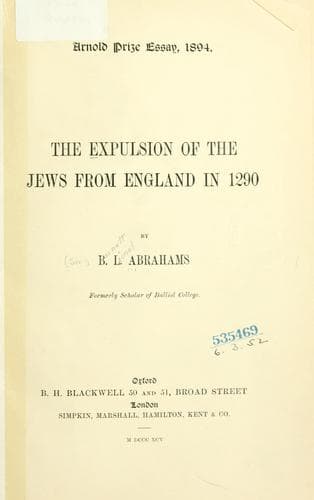
The expulsion of the Jews from England in 1290Abrahams, Barnett Lionel
History
The expulsion of the Jews from England in 1290
Abrahams, Barnett Lionel
Jews -- Great Britain -- History
For the Jews could no longer support the Crown in times of financial
difficulty as they had been able to do in previous reigns. The
contraction of their business that was the result of their exclusion
from many towns, and the losses that they had suffered through the
extortions of Henry III. and the plundering attacks of the barons,
had very greatly diminished their revenue-paying capacities, and the
legislation of 1270 must have affected them still more deeply. At the
end of the twelfth century they had probably paid to the Treasury about
£3,000 a year, or one-twelfth of the whole royal income,[98] and for
some parts of the thirteenth century the average collection of tallage
has been estimated at £5,000;[99] but in 1271--by which time the royal
income had probably grown to something like the £65,000 a year which
the Edwards are said to have enjoyed in time of peace[100]--Henry
III., when pledging to Richard of Cornwall the revenue from the
Jewry, estimated its annual value, apart from what was yielded by
escheats and other special claims, at no more than 2,000 marks.[101]
And while the resources of the Jews had fallen off, the needs of the
Crown had increased. Not only must Edward have conducted his foreign
enterprises at a much greater cost than did his predecessors, under
whom the English knighthood had been accustomed to serve without
serious opposition, but, in addition, he had to make the best of a vast
heritage of debt that his father had left him.[102] He had to seek
richer supporters than the Jews, and such were not wanting.
The Italian banking companies were the only organisations in Europe
that could supply him with such sums of money as he needed. From all
the greatest cities of Italy--from Florence, Rome, Milan, Pisa, Lucca,
Siena, and Asti--they had spread to many of the chief countries of
Europe, to France, England, Brabant, Switzerland, and Ireland.[103]
They were merchants, money-lenders, money-changers, and international
bankers, and in this last occupation their supremacy over all rivals
was secured by the great advantage which the wide extent of their
dealings enabled them to enjoy, of being able to save, by the use
of letters of credit on their colleagues and countrymen, the cost
of the transport of money from country to country.[104] They were
thus the greatest financial agents of the time. They transacted the
business of the Pope. At the Court of Rome ambassadors had to borrow
from them.[105] In France their position was established by a regular
diplomatic agreement between the head of their corporation and Philip
III.[106] In England they had in their hands the greater part of the
trade in corn and wool;[107] and the protection and favour of English
kings was often besought by the Popes on their behalf in special
bulls.[108]
Public-domain text, read in full here on John Shaqi.
Reviews
Reviews
No reviews yet
Be the first to share your thoughts on this work.
Join the Discussion
Join the discussion
Sign in to leave a comment or review.
Sign InorCreate an account