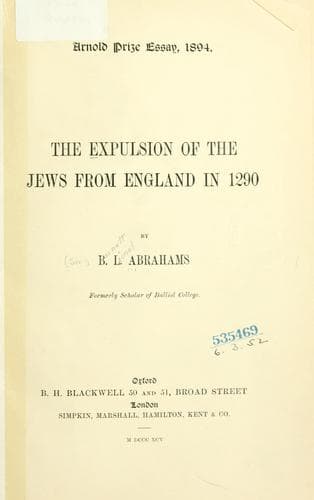
The expulsion of the Jews from England in 1290Abrahams, Barnett Lionel
History
The expulsion of the Jews from England in 1290
Abrahams, Barnett Lionel
Jews -- Great Britain -- History
Edward began his reign in financial dependence on the Italians. His
father had in the earliest period of his personal government incurred
obligations to them which he himself, as heir apparent, had to increase
considerably at the time of his Crusade.[109] When in later years
he needed money to pay his army, he borrowed it from them; when he
diverted to his own use the tenth that was voted for his intended
second Crusade, they gave security for repayment.[110] So great were
the amounts that they advanced to him, that between 1298 and 1308 the
Friscobaldi Bianchi alone, one of the thirty-four companies that he
employed,[111] received in repayment nearly £100,000.[112] He was
compelled to favour them, although he attempted to stop their usury. He
gave them a charter of privileges.[113] He presented them with large
sums of money. He bestowed on the head of one of their firms high
office in Gascony. At various times he placed under their charge the
collection of the Customs in many of the chief ports in England.[114]
Edward’s close connection with a body of financiers so rich and
powerful made the Jews unnecessary to him. If he was not to disobey the
decree of the Council of Lyons he must either withdraw his protection
from them or else forbid them any longer to be usurers. To withdraw his
protection from them would be to expose them to the popular hatred,
the danger from which had been the justification of the relations that
had been established between Crown and Jewry after 1190, and still
existed. He chose the second alternative. In 1275 he issued a statute,
in which he absolutely forbade the Jews, as he had just forbidden
Christians,[115] to practise usury in the future. He gave warning
that usurious contracts would no longer be enforced by the king’s
officers, and he declared the making of them to be an offence for which
henceforth both parties were liable to punishment. To ensure that all
those contracts already existing should come to an end as quickly as
possible, he ordered that all movables that were in pledge on account
of loans were to be redeemed before the coming Easter.[116]
VII.--EDWARD’S POLICY: THE JEWS AND TRADE.
Thus the Jews, already shut out from the feudal and municipal
organisation of the country, were forbidden by one act of legislation
to follow the pursuit in which the kings of England had encouraged them
for two hundred years.
Public-domain text, read in full here on John Shaqi.
Reviews
Reviews
No reviews yet
Be the first to share your thoughts on this work.
Join the Discussion
Join the discussion
Sign in to leave a comment or review.
Sign InorCreate an account