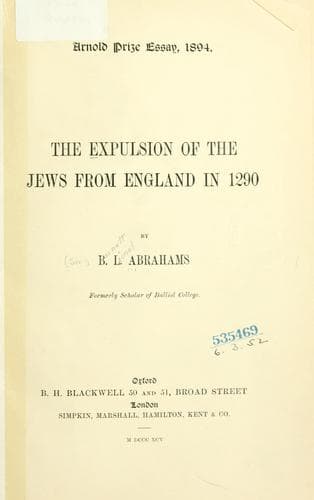
The expulsion of the Jews from England in 1290Abrahams, Barnett Lionel
History
The expulsion of the Jews from England in 1290
Abrahams, Barnett Lionel
Jews -- Great Britain -- History
Excluded from the trades and handicrafts of the towns, the Jew might
try other means of earning a livelihood. He might attempt to travel
with wares or with produce, from one part of England to another, or
he might be an importer or an exporter. But wholesale trade of this
kind would be open to those alone who had command of a large capital.
And this was not the only difficulty in the way. If the Jew went
about the country with his goods from fair to fair, or from city to
city, he would do so at very great risk. He would have to travel over
the high roads, the perils of which made necessary the Statute of
Winchester, and are recounted in the words of its preamble, _de jour
en jour roberies, homicides, arsons, plus sovenerement sont fetes que
avaunt ne soleyent_.[134] If he survived the dangers of the road and
reached a fair, he would find there an assemblage made up in part of
“daring persons,” such as those, who, in spite of the orderly traders
and citizens, had caused the massacre at Lynn in 1190,[135] or those
who at Boston killed the merchants and plundered their goods, until
“the streets ran with silver and gold,”[136] or those citizens of
Winchester who, in the reign of Henry III., carried on for a time a
successful conspiracy to rob all itinerant merchants who passed through
the country.[137] With his foreign face and striking badge, he would be
the first mark for the hatred of the riotous crowd. And if he escaped
violence and robbery, he had still to fear the officials of the lord of
the fair, who exercised for the time unlimited and irresponsible power,
and who, according to the regulations of some fairs, could destroy the
goods of any trader if their quality did not please them.[138] When he
had managed to escape from the mob and the officials, his difficulties
were not over. He might make his bargains, but there was no court of
justice to which he could appeal to enforce the completion of any
transaction that required a longer time than that of the duration of
the fair. Redress for any injustice committed at a fair, or for the
failure to carry out an agreement made there, could be obtained only
through application made by the municipality of the complainant to that
of the wrong-doer.[139] The Jew had no municipality to present his
claims. If those with whom he had transactions deceived him, or refused
to pay him, he was helpless. There was no power to which he could
appeal.
Public-domain text, read in full here on John Shaqi.
Reviews
Reviews
No reviews yet
Be the first to share your thoughts on this work.
Join the Discussion
Join the discussion
Sign in to leave a comment or review.
Sign InorCreate an account