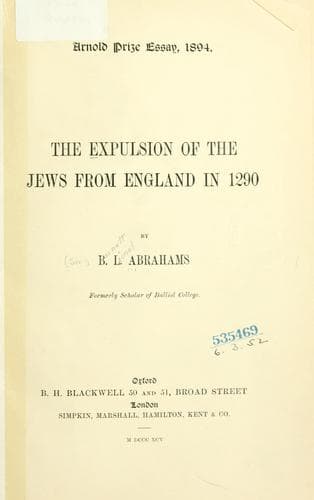
The expulsion of the Jews from England in 1290Abrahams, Barnett Lionel
History
The expulsion of the Jews from England in 1290
Abrahams, Barnett Lionel
Jews -- Great Britain -- History
If instead of going to a fair he tried to sell, in a town, produce
from another country or from a different part of England, he was in
a position of even greater difficulty. In a strange town he was as
much an alien as in a strange country, and there was scarcely any
limit to the vexations and sufferings that on that account he would
have to endure. In London, for example, alien merchants were forbidden
to remain in the city for more than forty consecutive days. While
they were there they might not sell anything by retail, nor have any
business dealings at all with any but citizens. There was a long list
of articles that they were altogether forbidden to buy. They might not
stow their goods in houses or cellars; they had to sell within forty
days all that they had brought with them; they were allowed neither to
sell anything after that time, nor to take anything back with them.
They were continually annoyed by the officers of the city.[140] All
these disadvantages the Jew would have to endure to the full while
competing with many powerful organisations which were engaged in
foreign trade, and had, after long struggles, secured from the king
special charters of privilege. Such were the companies of the merchants
of Germany, who had their steelyard in London and their settlements
at Boston and Lynn; the Flemings, who had their Hanse in London; the
Gascons who enjoyed a charter; the Spaniards and Portuguese; the
Florentines, most powerful of all, and the Venetians, whose enterprise
was, at the beginning of the fourteenth century at any rate, carried on
under the auspices of the Republic.[141]
The last opportunity for the Jews was to take part in the export
of English produce. English wool was the most important article of
international trade in Western Europe. It was brought from monasteries
and landholders chiefly by the rich and powerful companies of Flemish
and Italian merchants, and sent to Flanders and Italy to be woven and
dyed.[142] The Jews had, apparently, long taken some slight part in
wholesale trade,[143] but the amount of capital that it required, and
the power of the rivals who held the field, made it impossible for many
of them to take to it immediately as a substitute for money-lending.
Still it was the only form of enterprise in which they would not be at
a hopeless disadvantage; and some Jews, those probably who had a large
capital and were able to recall it from the borrowers, followed the
example of the Italians, and made to landholders advances of money to
be repaid in corn and wool.[144]
VIII.--THE TEMPTATIONS OF THE JEWS.
Public-domain text, read in full here on John Shaqi.
The expulsion of the Jews from England in 1290 — John Shaqi
Reviews
Reviews
No reviews yet
Be the first to share your thoughts on this work.
Join the Discussion
Join the discussion
Sign in to leave a comment or review.
Sign InorCreate an account