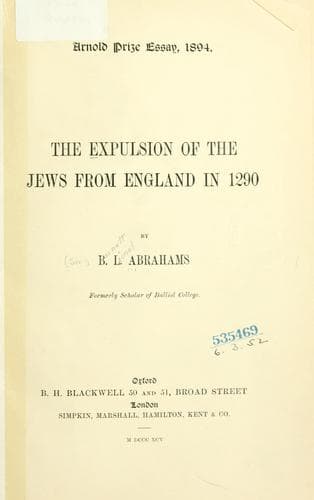
The expulsion of the Jews from England in 1290Abrahams, Barnett Lionel
History
The expulsion of the Jews from England in 1290
Abrahams, Barnett Lionel
Jews -- Great Britain -- History
But even for those Jews who were rich enough to take part in wholesale
trade, there was still a great temptation to transgress the prohibition
against usury. All the legal machinery that was necessary for the due
execution and validity of agreements between Jews and Christians--the
chest in which the deeds were deposited, and the staffs of officers
by whom they were registered and supervised--were still maintained in
some towns, since they were necessary alike for the recovery, by the
ordinary process, of the old debts (many of which, in spite of the
order for summary repayment in the Statute of 1275, still remained
outstanding)[145] and for the registration of any new agreements that
might be made for the delivery of corn and wool, or for the repayment
of money lent ostensibly without interest. There was no lack of
would-be borrowers to co-operate with the Jews in using this machinery
in order to make agreements on which, in spite of the prohibition of
usury, money might profitably be lent. The demand for loans was great,
far too great to be satisfied, as the Church thought it reasonable
to expect,[146] by money advanced without interest; and owing to the
progress of the change from payment of rents in kind or service to
payment in cash,[147] it was steadily growing. It had been met by the
money of the Italian bankers, of the Jews, of English citizens, and,
as is freely hinted by writers of the time, of great English barons,
who secretly shared in the transactions and the profits of the Jewish
and foreign usurers.[148] The supply had suddenly been checked by the
simultaneous prohibition of all usury whether of Jews or of Christians.
Now a Jew who wished, by collusion with a borrower, to evade the law
against usury, had only to study the methods that had been followed
by the Caursines, and those that were still followed by the Italians
and acquiesced in by the heads of the religious houses with whom
they had dealings. The Caursines, for example, sometimes avoided the
appearance of usury by lending 100 marks and receiving in return a
bond, acknowledging a loan of £100.[149] Sometimes they lent money for
a definite period, on an agreement that they were to get a “gift,”
in return for their kindness in making the loan, and “compensation”
in case it were not repaid in time.[150] Sometimes by a still more
elaborate device, the Italians combined their two professions of
money-lenders and merchants, by inducing a monastery which had borrowed
money, to acknowledge the receipt, not only of the sum actually
received, but also of the price of certain sacks of wool which it bound
itself in due time to supply.[151] The Jews, no doubt, followed the
example of the Caursines and of the Italians. In official registers,
which are still extant, there are mentioned bonds which secured to
Jewish creditors a large payment in money together with a small payment
in kind, and which doubtless represent collusive transactions, in
Public-domain text, read in full here on John Shaqi.
Reviews
Reviews
No reviews yet
Be the first to share your thoughts on this work.
Join the Discussion
Join the discussion
Sign in to leave a comment or review.
Sign InorCreate an account