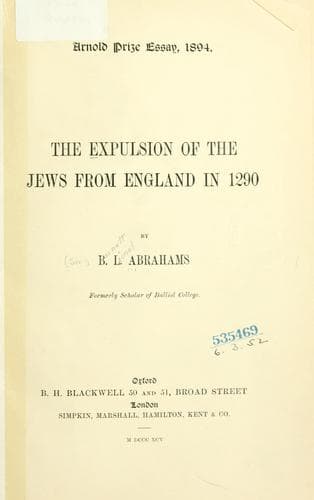
The expulsion of the Jews from England in 1290Abrahams, Barnett Lionel
History
The expulsion of the Jews from England in 1290
Abrahams, Barnett Lionel
Jews -- Great Britain -- History
The activity with which Jews took part, or were supposed to take part,
in the debasement of the coinage, and in the prohibited practice of
usury,[178] must have aroused in the mind of the King some misgivings
on the subject of his new policy. Nevertheless, he did not as yet
despair of its ultimate success. The crimes of the Jews were no
greater than those of the Christians around them, though they called
forth heavier punishment. Christians clipped and coined; Christians
still lent money on usury.[179] And a certain amount of crime among
Jews could not but be looked for as a natural result of the terrible
difficulties in the way of the social revolution that had been demanded
of them. Edward saw that he had been trying to do too much at once. The
Jews could not change their occupation as suddenly as he had wished.
The country could not do without money-lenders. By making the lending
of money at interest a penal offence, and thus encouraging debtors and
creditors to keep their transactions secret, Edward had weakened the
supervision that had been exercised by the Treasury, since 1194, over
the business and property of the Jews, and thus he had increased the
chance of fraud in the collection of tallages, and in the apportionment
of the share of each estate that had long been claimed by the Crown
as the succession due on Jewish property.[180] But he had not stamped
out usury, though the Statute of 1275 had forbidden it. He had not even
secured the redemption of all pledges of Christians from the hands of
the Jews, though the Statute of 1275 had demanded it. And, therefore,
in order that he might not keep on the Statute Book a law of which the
effective administration was impossible, he mitigated the severity of
the provisions of 1275, and issued, probably a few years later, a new
Statute, in which he prescribed certain conditions under which usury
was to be permitted. He allowed loans to be made under contract for the
payment of interest at the rate of half a mark in the pound yearly,
but for three years only; and, in order to reduce the temptation to
conclude secret transactions, restored legal recognition to all debts
of the value of £20 or upwards that were made under the prescribed
conditions, and were registered before the chirographer and clerk,
and threatened heavy penalties against all who should lend up to that
amount without registration.[181]
Public-domain text, read in full here on John Shaqi.
Reviews
Reviews
No reviews yet
Be the first to share your thoughts on this work.
Join the Discussion
Join the discussion
Sign in to leave a comment or review.
Sign InorCreate an account