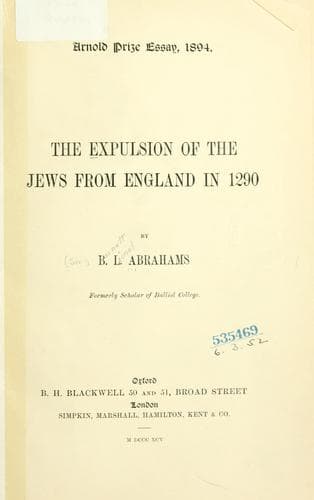
The expulsion of the Jews from England in 1290Abrahams, Barnett Lionel
History
The expulsion of the Jews from England in 1290
Abrahams, Barnett Lionel
Jews -- Great Britain -- History
Edward was wise in thus substituting for his earlier, harassing
measure, one that allowed for gradual change, and that attempted to
control the evil of which the immediate suppression was impossible. But
the few years’ experience that he had already had ought to have made
him go farther still. It ought to have shown him that it was hopeless
to expect the Jews to give up usury so long as the greater part of them
were practically excluded from all other pursuits, and that, if ever he
was to bring to a successful issue the policy that he had inaugurated,
he would have to find some means of enabling them to work side by side
with Christians, and to compete with them on equal conditions.
Such a task would have been full of difficulties, the greatest of
which resulted from the active hostility with which the rulers and
teachers of the Christian Church in the thirteenth century, unlike
their predecessors, regarded the Jews. The growth and nature of this
hostility must now be considered.
IX.--THE JEWS IN RELATION TO THE CHURCH OF THE THIRTEENTH CENTURY.
The Popes of the earlier part of the Middle Ages had found enough
employment for their energies in the effort to maintain their own
position in Christendom; and they had neither the wish nor the power to
seek a conflict with a race that remained wholly outside the Church.
In the twelfth century there was no other general Church Law directed
against the Jews than that which forbade them to live in the same
houses with Christians, and to have Christian servants.[182] In England
especially, Churchmen of the twelfth century showed towards the Jews
a tolerant spirit, and made no effort to augment their unpopularity
or to diminish their privileges. The examples of Anselm, and of his
contemporary, Gilbert of Westminster, show that in the attempts made at
that time by men of high position in the Church to convert the Jews, no
method was employed except that of reasonable persuasion.[183] Churches
and monasteries took charge, at times of danger, of the money, and
even of the families, of Jews. Such friendly intercourse as existed
between Jews and Christians was allowed to go on without any attempt at
ecclesiastical interference.[184]
Public-domain text, read in full here on John Shaqi.
Reviews
Reviews
No reviews yet
Be the first to share your thoughts on this work.
Join the Discussion
Join the discussion
Sign in to leave a comment or review.
Sign InorCreate an account