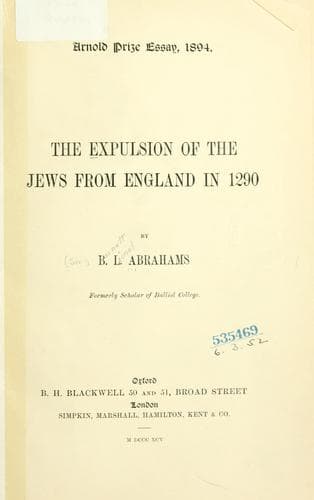
The expulsion of the Jews from England in 1290Abrahams, Barnett Lionel
History
The expulsion of the Jews from England in 1290
Abrahams, Barnett Lionel
Jews -- Great Britain -- History
The accession of Innocent the Third to the pontificate brought about a
rapid change in the attitude of the Church towards the Jews. Innocent
was the first to advance, on behalf of the Papacy, the claim that the
Lord gave Peter not only the whole Church, but the whole world to
rule,[185] and he endeavoured with a merciless enthusiasm, from which
all unbelievers and heretics in Christian countries had to suffer, to
make good his claim, and to establish in Europe one united Catholic
Church. He took his stand on the doctrine, which his predecessors had
held[186] in a modified form, and without ever acting on it, that the
Jews were condemned to perpetual slavery on account of the wickedness
of their ancestors in crucifying Christ; and he thought that they ought
to be made to feel, and their neighbours likewise, that it was only
out of Christian pity that their presence was endured in Christian
countries.
The position of the Jews at the time of Innocent’s accession to the
pontificate was very far from being such as his theory required. They
had magnificent synagogues, they employed Christian servants, they
married, or were said to marry, Christian wives; they refused, in what
some Christians regarded as a spirit of outrageous insolence, to eat
the same meat and to drink the same wine as the Gentiles, and they made
no secret of their disbelief in the sacred history of Christianity.
Moreover, they were suspected of exercising a considerable influence on
the growth of the heresies which it was the chief work of Innocent’s
life to combat. The Vaudois, the Cathari, and the Albigenses, all
kept up Jewish observances, and were said to have learnt from the
Jews their heretical dogmas; the Albigenses, indeed, were accused of
maintaining that the law of the Jews was better than the law of the
Christians. And, nevertheless, Christian kings supported the Jews
in every way. They countenanced their usury, they refused (so, at
least, Innocent said) to allow evidence against them on any charge
to be given by Christian witnesses, and they even employed them in
high offices of State. In view of these facts, Innocent thought that
a great effort of repression should be made, and he wrote to the King
of France, the Duke of Burgundy, and other monarchs, asking for their
assistance in the work of reducing the Jews to that condition of
slavery which was their due. He decreed in his general Church Council
that Jews should be excluded in future from public offices, and that
they should wear a badge to distinguish them from Christians; and
he renewed the old regulation of the Church, which required them to
dismiss Christian servants from their houses. In order to ensure that
the last provision should be observed, he decided that any Christians
having any intercourse with Jews that transgressed it should be subject
to excommunication. For the enforcement of his other anti-Jewish
measures he relied on the help of the temporal power in all Christian
countries.[187]
Public-domain text, read in full here on John Shaqi.
Reviews
Reviews
No reviews yet
Be the first to share your thoughts on this work.
Join the Discussion
Join the discussion
Sign in to leave a comment or review.
Sign InorCreate an account