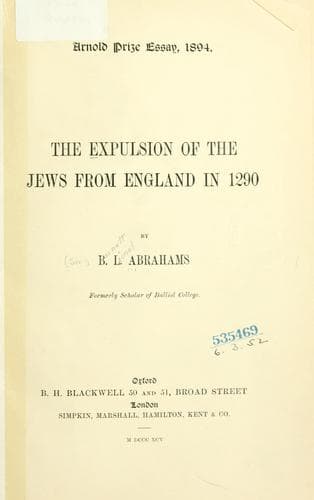
The expulsion of the Jews from England in 1290Abrahams, Barnett Lionel
History
The expulsion of the Jews from England in 1290
Abrahams, Barnett Lionel
Jews -- Great Britain -- History
Edward was too religious to disregard the wishes of the Pope, expressed
thus formally and solemnly and with the utmost strength of language.
And he had special reasons for paying heed to the words of Honorius
IV., on whose money-lenders he was dependent for loans, and whose
predecessor had, by the exercise of his spiritual powers, secured for
him a tenth part of the goods of the clergy of England.[218] From the
moment of the issue of the bull, the policy inaugurated by the statute
of 1275 was doomed. For of the two alternatives that Edward would have
had before him in any further Jewish legislation that he might have
undertaken--the alternatives of the abandonment of the policy of 1275,
or the extension of it by further measures for the assimilation of the
status of Jews to that of Christians--the Church now demanded that he
should at once adopt the former. It demanded that the Jews of England
should live isolated from the Christians; and this they could do only
so long as they kept to pursuits, such as usury, for the practice of
which they required no connection with the organisation of a gild or a
town.
For a time Edward could take no decisive measures, since when the
bull reached England, he had left for Gascony.[219] In that province
nothing had apparently as yet been done to satisfy the demand made by
the Council of Lyons, in 1274, that alien usurers should no longer be
tolerated in the land of Christians. It was hopeless to try to enforce
in a distant dependency the policy that had been beset in England with
so many difficulties, and had now incurred the direct opposition of the
Church. The only alternative was expulsion, a measure that on French
soil suggested itself the more naturally, since two French kings had
practically adopted it already. Before he returned home, Edward issued
an order that all Jews should leave Gascony.[220]
The application of the same measure in England was a more serious
matter, since the English Jews were doubtless a much larger community
than those of Gascony. But, determined not to tolerate them as usurers,
and convinced of the hopelessness of his efforts to change them into
traders, Edward had no alternative but to treat them as he had treated
their coreligionists in Gascony.
No doubt he was influenced in his resolution by the members of his
family and court. His wife and mother and various of his officers had
been in the habit of receiving liberal grants from the property and
forfeitures of the Jews.[221] They must have known that this resource
was decreasing steadily, and was not worth husbanding, and they must
have welcomed a measure which would bring into the King’s hands a
fairly large amount of spoil capable of immediate distribution. And,
probably, some of the ecclesiastical members of the court felt, as
his mother certainly did,[222] a religious hatred of the Jews and a
religious joy at the prospect of their disappearance.
XI.--THE EXPULSION.
Public-domain text, read in full here on John Shaqi.
Reviews
Reviews
No reviews yet
Be the first to share your thoughts on this work.
Join the Discussion
Join the discussion
Sign in to leave a comment or review.
Sign InorCreate an account