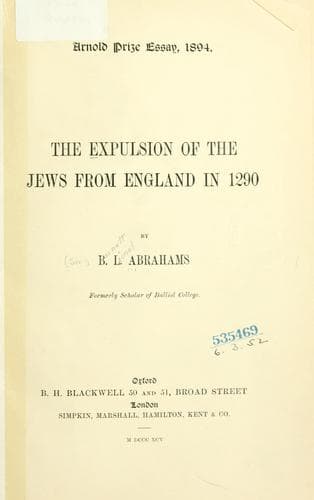
The expulsion of the Jews from England in 1290Abrahams, Barnett Lionel
History
The expulsion of the Jews from England in 1290
Abrahams, Barnett Lionel
Jews -- Great Britain -- History
Of the course of events for the first few months after Edward’s return
to England, very meagre accounts have come down to us. His searching
inquiry into the conduct of the judges during his absence[223] must
have taken up most of his time and energy. As soon as he had meted out
punishment to those whom he had found guilty of corruption, he turned
to the Jewish question. On the 18th of July, 1290, writs were issued to
the sheriffs of counties, informing them that a decree had been passed
that all Jews should leave England before the feast of All Saints of
that year.[224] Any who remained in the country after the prescribed
day were declared liable to the penalty of death.[225]
Every effort was made by the King to secure the peace and safety
of the Jews during the short period for which they were allowed to
remain, and in the course of their journey from their homes to the
coast, and from the coast to their ultimate destination. The sheriffs
were ordered to have public proclamation made that “no one within the
appointed period should injure, harm, damage, or grieve them,” and
were to ensure, for such as chose to pay for it, a safe journey to
London. The wardens of the Cinque Ports, within the district of whose
jurisdiction many of the Jews would necessarily embark, received orders
in the same spirit as those that had been addressed to the sheriffs of
the counties. They were to see that the exiles were provided, after
payment, with a safe and speedy passage across the sea, and that the
poor among them were enabled to travel at cheap rates and were treated
with consideration.[226] These general orders were reinforced by the
issue of special writs of safe-conduct for individual Jews.[227] The
exiles were allowed to carry with them all of their own property that
was in their possession at the time of the issue of the decree of
expulsion, together with such pledges deposited with them by Christians
as were not redeemed before a fixed date. A few Jews who were high in
the favour of royal personages, such as Aaron, son of Vives, who was a
“chattel” of the King’s brother Edmund,[228] and Cok, son of Hagin, who
belonged to the Queen,[229] were allowed before their departure to sell
their houses and fees to any Christian who would buy them.
Public-domain text, read in full here on John Shaqi.
Reviews
Reviews
No reviews yet
Be the first to share your thoughts on this work.
Join the Discussion
Join the discussion
Sign in to leave a comment or review.
Sign InorCreate an account