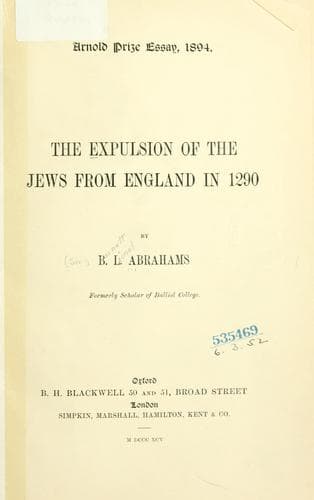
The expulsion of the Jews from England in 1290Abrahams, Barnett Lionel
History
The expulsion of the Jews from England in 1290
Abrahams, Barnett Lionel
Jews -- Great Britain -- History
The disasters that followed the first Crusade brought with them
an increase in the ferocity of the attacks to which the Jews of
Continental Europe were subjected, and S. Bernard, when he preached
the second Crusade, found that he had revived a spirit of fanaticism
that he was powerless to quell. He had wished for the reconquest of
the Holy Land as a result that would bring honour to the Christian
religion; but his followers and imitators thought less of the end than
of the bloodshed that was to be the means. A monk, “who skilfully
imitated the austerity of religion, but had no immoderate amount of
learning,”[11] went through the Rhineland preaching that all Jews
who were found by the Crusaders should be killed as enemies of the
Christian faith. It was in vain that Bernard appealed to the Christian
nations whom his eloquence had aroused, in the hope that “the zeal of
God which burnt in them would not fail altogether to be tempered with
knowledge.” He himself narrowly escaped attack: and the Jews suffered
from the second Crusade as they had suffered from the first.[12]
England was so closely related to the Churches of the Continent that
it could not fail to be affected by the great movement. But the first
Crusade was preached when the Conquest was still recent, and the
Normans had no leisure to leave their new country; the second, during
the last period of anarchy in the reign of Stephen.
Thus there were, during the first hundred years after the Council of
Clermont, few English Crusaders. Yet the Crusading spirit, working
in a superstitious mediæval population, called forth a danger that
was destined to be as fatal to the English Jews as were the massacres
to their brethren on the Continent. The Pope who preached the first
Crusade had told his hearers that Eastern nations were in the habit of
circumcising Christians and using their blood in such a way as to show
their contempt for the Christian religion. This charge was naturally
extended to the Jews as well. What alterations it underwent in its
circulation it is hard to say; but in 1146, a tale was spread among
the populace of Norwich, and encouraged by the bishop, that the Jews
had killed a boy named William, to use his blood for the ritual of
that most suspicious feast, their Passover. The story was supported by
no evidence more trustworthy than that of an apostate Jew, which was
so worthless that the Sheriff refused to allow the Jews to appear in
the Bishop’s Court to answer the charge brought against them, and took
them under his protection. But the popular suspicion of the Jews lent
credibility to the story, and so terrible a feeling was aroused that
many of the Jews of Norwich dispersed into other lands, and of those
who remained many were killed by the people in spite of the protection
of the Sheriff.[13] The accusation once made naturally recurred, first
at Gloucester, in 1168, and then at Bury St. Edmund’s, in 1181. “The
Public-domain text, read in full here on John Shaqi.
Reviews
Reviews
No reviews yet
Be the first to share your thoughts on this work.
Join the Discussion
Join the discussion
Sign in to leave a comment or review.
Sign InorCreate an account