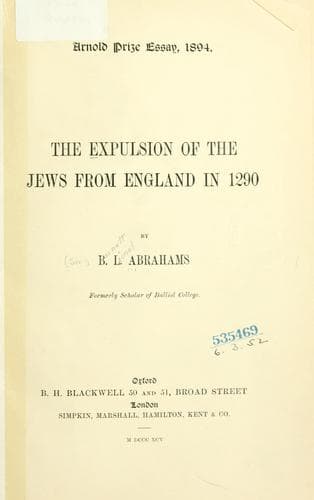
The expulsion of the Jews from England in 1290Abrahams, Barnett Lionel
History
The expulsion of the Jews from England in 1290
Abrahams, Barnett Lionel
Jews -- Great Britain -- History
Martyrs” were regularly buried in the nearest church or religious
house, and the miracles that they all worked would alone have been
enough to continually renew the belief in the terrible story.[14]
Under the firm reign of Henry II., anti-Jewish feeling found no further
expression in act. The King, like his predecessors, gave and secured
to the Jews special privileges so great as to arouse the envy of their
neighbours. They were allowed to settle their own disputes in their own
_Beth Din_, or Ecclesiastical Court, and in so far to enjoy a privilege
that was granted only under strict limitations to the Christian
Church.[15] They were placed, apparently, under the special protection
of the royal officers of each district.[16] They lived in safety, and
they made considerable contributions to the Royal Exchequer.
The death of Henry II. and the accession of Richard I., the first
English Crusading King, brought trouble, as was but natural, to the
rich and royally favoured infidels of the land where the blood
accusation had its birth. The interregnum between the death of one
King and the proclamation of the “peace” of his successor was always
a time of danger and lawlessness during the first two centuries after
the Conquest, and the growth of the crusading spirit, and of the
popular belief in the truth of the blood accusation, caused all the
forces of disorder to work in one direction, viz., against the Jews.
The day of Richard’s coronation was the first opportunity for a great
exhibition of the anti-Jewish fanaticism of the populace. The nobles
from all parts of the country brought with them to London large trains
of servants and attendants, who were left to occupy themselves as
best they might in the streets, while their lords were present at the
ceremony. The Jews, who had been refused permission to enter the Abbey,
took up a prominent position outside. Their appearance exasperated the
crowd, and in the mediæval world a crowd was irresistible. While the
service was proceeding, the Jews were fiercely attacked by the “wild
serving men” of the nobles and the lower orders of citizens. One at
least was compelled to accept baptism to save himself from death. Later
in the same day, when the King and magnates were banqueting in the
palace, the attack on the Jews was renewed. The strong houses of the
Jewry were besieged and fired, and the inhabitants were massacred. But
soon “avarice got the better of cruelty,” and in spite of the efforts
of the King’s officers the city was given up to plunder and rapine.[17]
Public-domain text, read in full here on John Shaqi.
Reviews
Reviews
No reviews yet
Be the first to share your thoughts on this work.
Join the Discussion
Join the discussion
Sign in to leave a comment or review.
Sign InorCreate an account